


Step back in time as you explore Marshall’s beautiful historic homes, each with unique architecture and stories to tell.
Take this short walking tour through Marshall’s beautiful downtown and learn about American history in a fun new way, through its flags!
Follow the flag banners downtown as noted on the map and you’ll journey through the birth of American during the Revolutionary War, the conflicted nation during the Civil War, historic moments during WWII, and how the flag played pivotal roles along the way. Flags on display April - November.

QUICK FLAG FACTS
•There have been 27 official American flags since America won Independence from the British in 1776. During the Revolutionary War (1775-1783) there were also many regimental or garrison flags that represented the country.
•Stars have been added to our flag as new states joined the nation. Our current flag has 50 stars, one for each state, and 13 stripes, representing the original 13 colonies.
•In 1986, President Reagan noted that American flag colors signified the human qualities that Americans cherish the most; Red for courage and readiness to sacrifice, White for pure intentions and high ideals, and Blue for vigilance and justice.
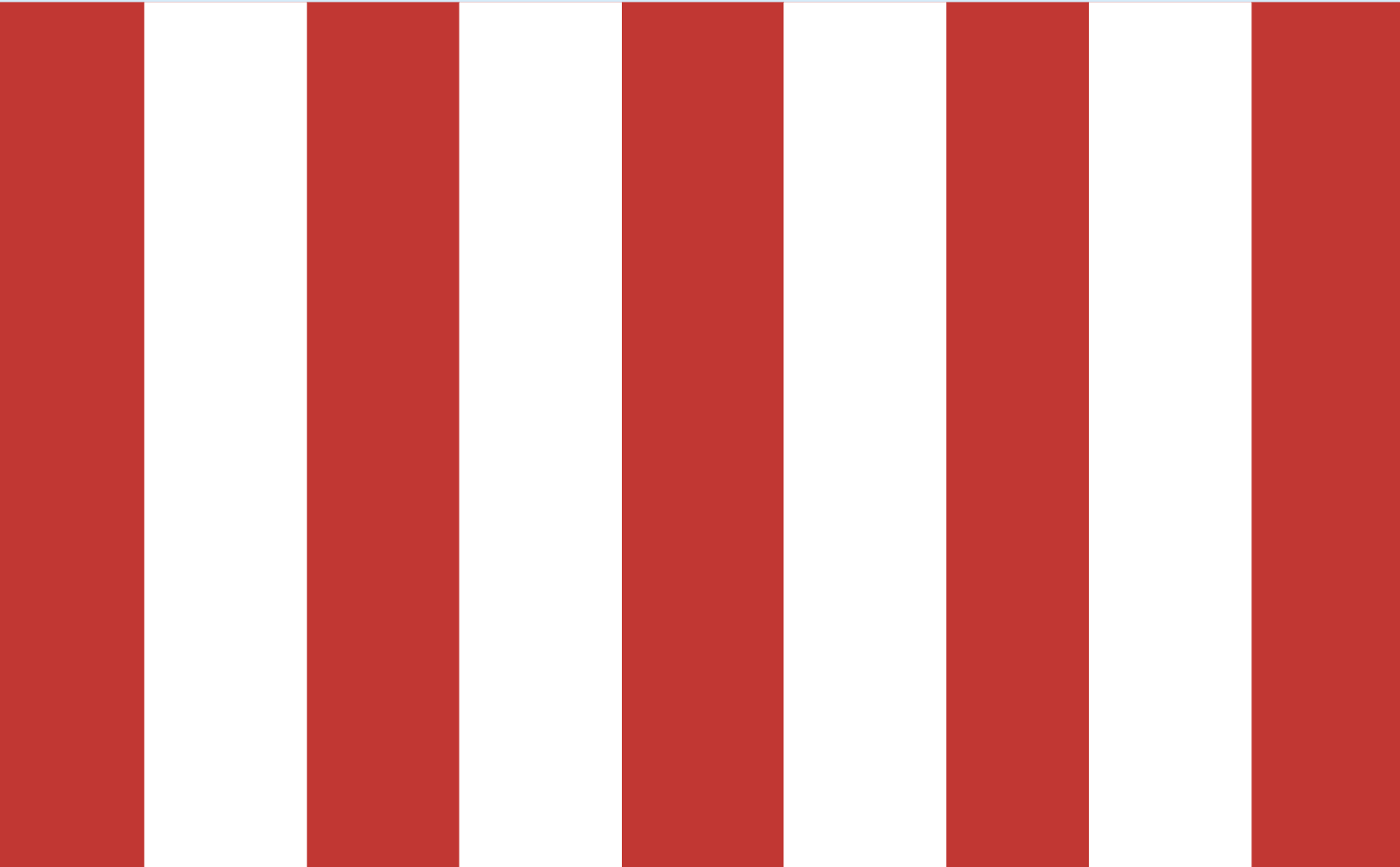
1. Sons of Liberty Flag / Rebellious Stripes Flag
The French and Indian War (1754 to 1763), established British rule over a portion of eastern North America. After the war, taxes were imposed on the colonists to pay off the British war debt. One tax was The Stamp Act of 1765, which required materials printed in the colonies (legal documents, playing cards, newspapers, etc) to be printed on paper produced in England and marked with an embossed revenue stamp.
A group of colonists began to protest the new tax under a tree in Boston, which became known as the Liberty Tree. The British cut the tree down. The protesters, called the Sons of Liberty, answered by erecting a Liberty Pole in its place and flying this red and white vertically-striped flag from it.
The Tea Act of 1773 declared that the only East India Company tea that could be sold in America. The Sons of Liberty protested this Act by dressing as Mohawk Indians and dumping 92,000 pounds of East India tea into Boston Harbor, an act now known as the Boston Tea Party. A vital concern of colonial protesters was that most of them had no vote in England, no say in American taxes or laws. Their rallying cry became “No taxation without representation!”
2. Bedford Flag
Trying to retain control, British troops tried to seize colonial weapons in Concord, Massachusetts but were met with resistance. As opposing sides eyed each other, tensions grew, and then someone fired the “shot heard ‘round the world.” April 19, 1775 marks the shift from colonial protest to armed conflict and the first military engagement of the Revolutionary War, the Battle of Lexington and Concord.
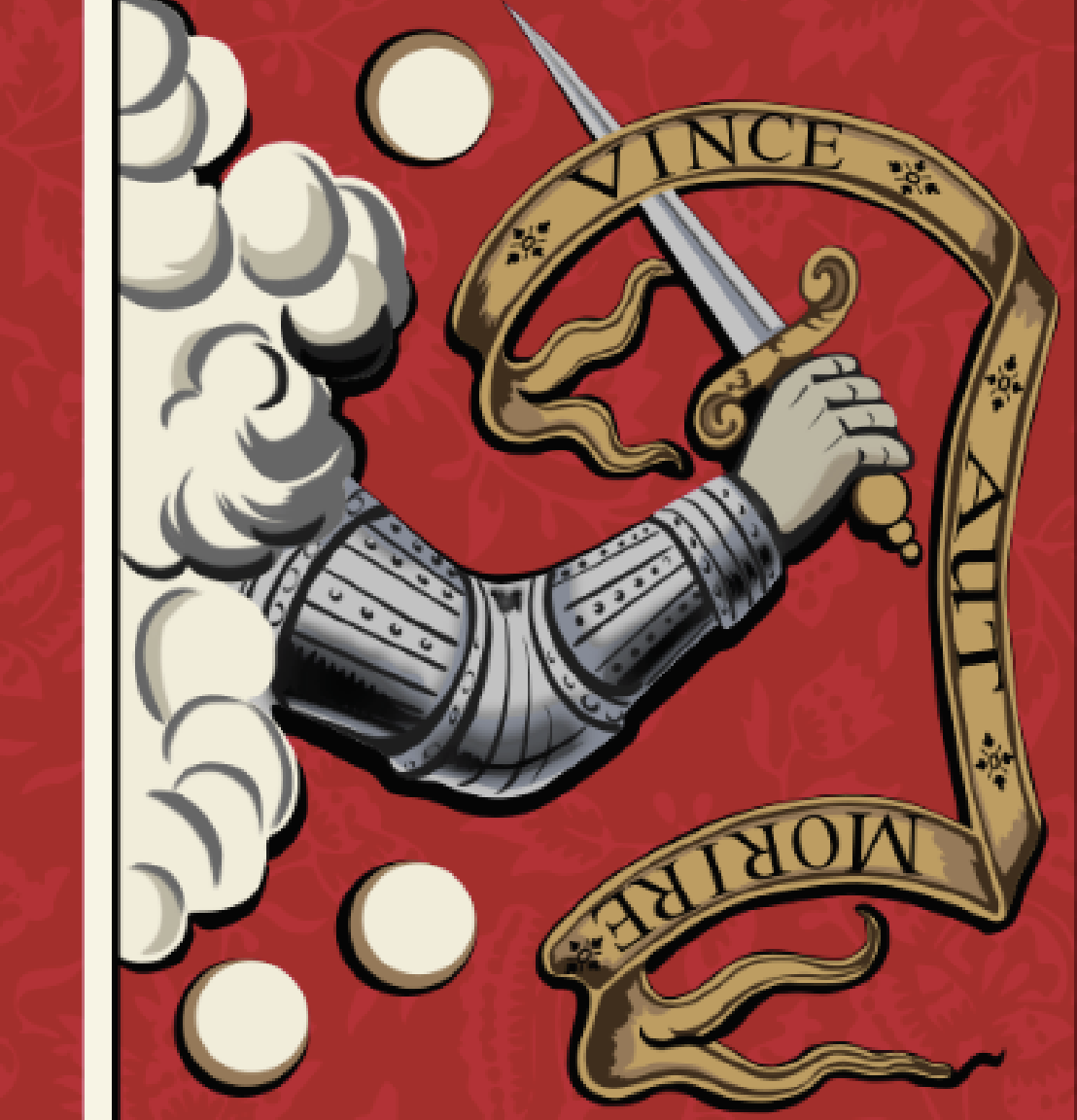
The Bedford Flag may be the oldest American flag known to exist. This flag was first used by a mounted militia unit in 1772, then carried in the French and Indian War, and finally taken into battle at Concord Bridge. It shows an armored arm grasping a sword coming out of a cloud and the Latin motto Vince Aut Morire, which translates to “Conquer or Die.”
3. Forster Flag

This is the first American flag known to have 13 stripes to represent the 13 colonies. It was originally a British Red Ensign flag, but the upper left corner was cut out and replaced with 13 alternating red and white stripes. It was carried by the Manchester Militia into the Lexington battle, but by the time the militia arrived, the British were already in retreat. The flag was named for their 1st Lieutenant, Samuel Forster.
4. Continental Flag
In June 1775, the Second Continental Congress voted to incorporate colonial-based Patriot militias into a central military, the Continental Army, and unanimously appointed Washington its commander-in-chief.
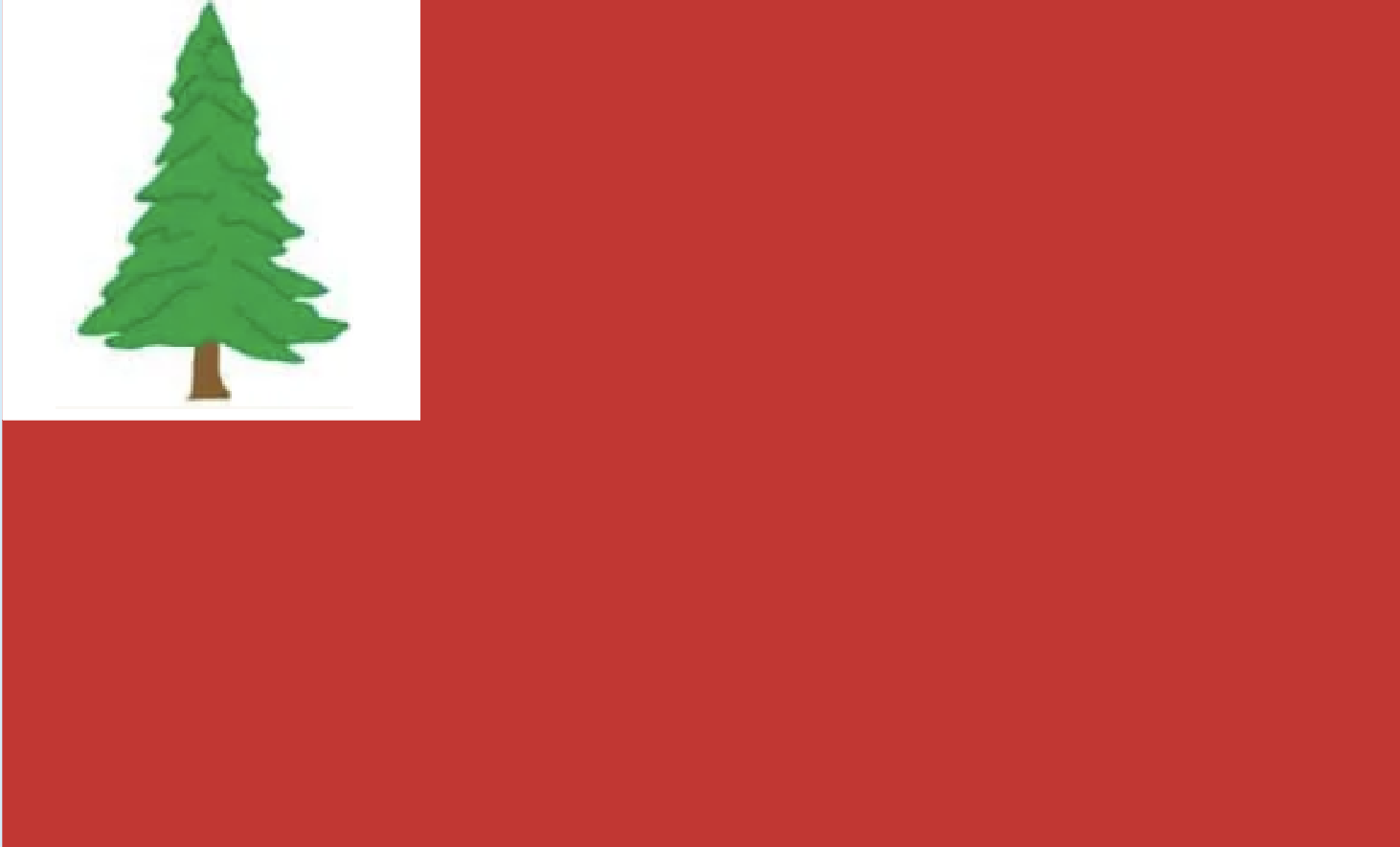
Americans fought for control of Bunker Hill in June 1775. British accounts of the skirmish describe a red flag flying on the American side. There is no way to verify that the flag shown was the one flown in the battle, but famous Revolutionary War artist John Trumbull spoke with eyewitnesses and chose this flag to paint in his “Battle at Bunker’s Hill” painting (its faint, but its there).
The British would take the best pine trees from New England forests to be used as masts for the Royal Navy, which enraged the colonists. Eastern white pine trees on flags soon symbolized defiance against British rule. A green tree on a white background appears on another well-known flag. The founding fathers were fans of John Locke and included that philospher’s words “An Appeal to Heaven” on that flag.
5. Hulbert Flag
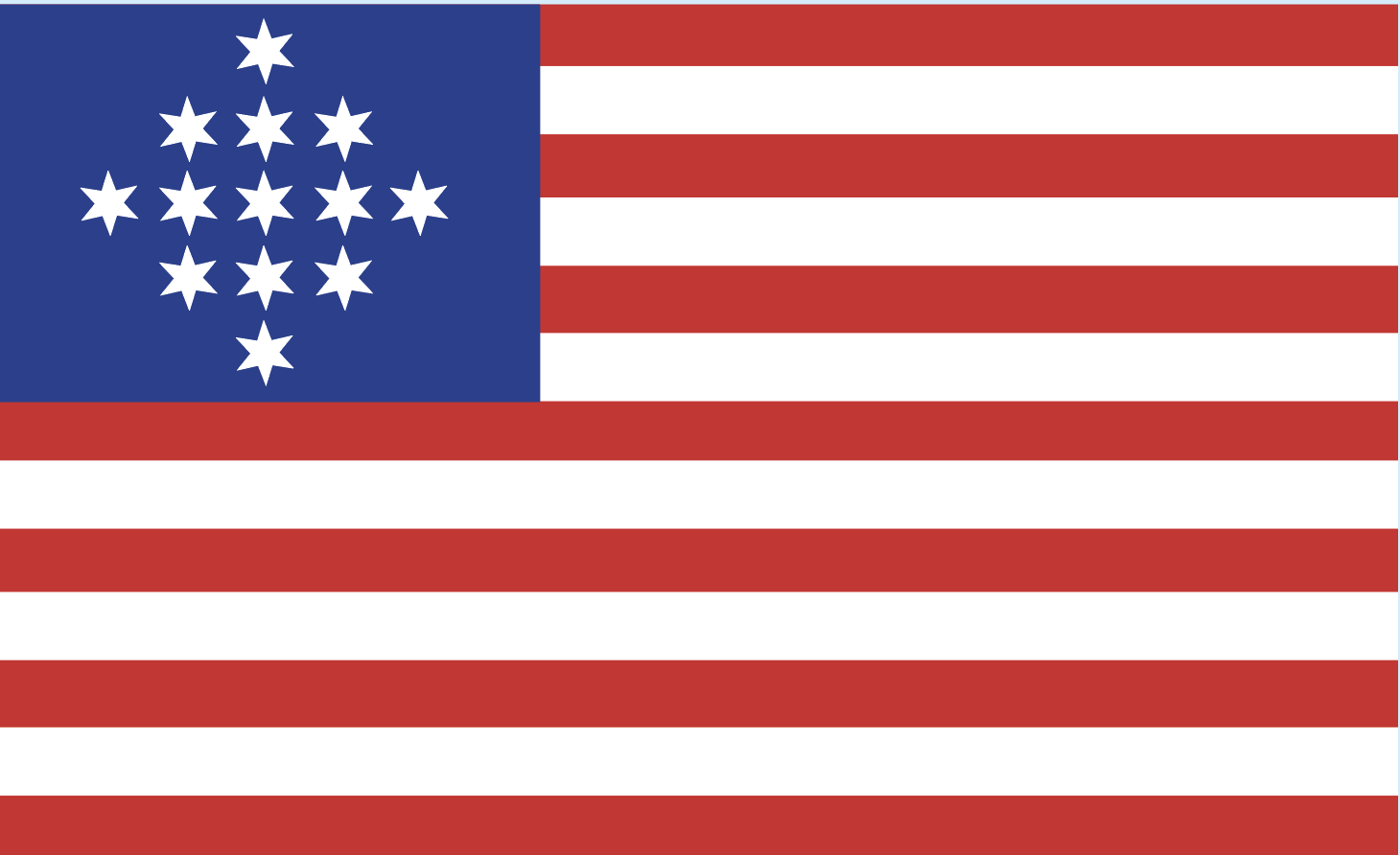
The New York Militia, under Capt. John Hulbert, was ordered to Fort Ticonderoga in October 1775 to protect Long Island from British raiding parties. It is said that Capt. Hulbert spent part of his time there creating this flag, which combined 13 red and white stripes with something new, stars!
In 1926, this tattered flag was found wrapped in paper, along with some of Capt. Hulbert’s orders, in the rafters of a barn that had once belonged to him. This flag may be the oldest “Stars and Stripes” in existence.
6. Navy Jack Flag
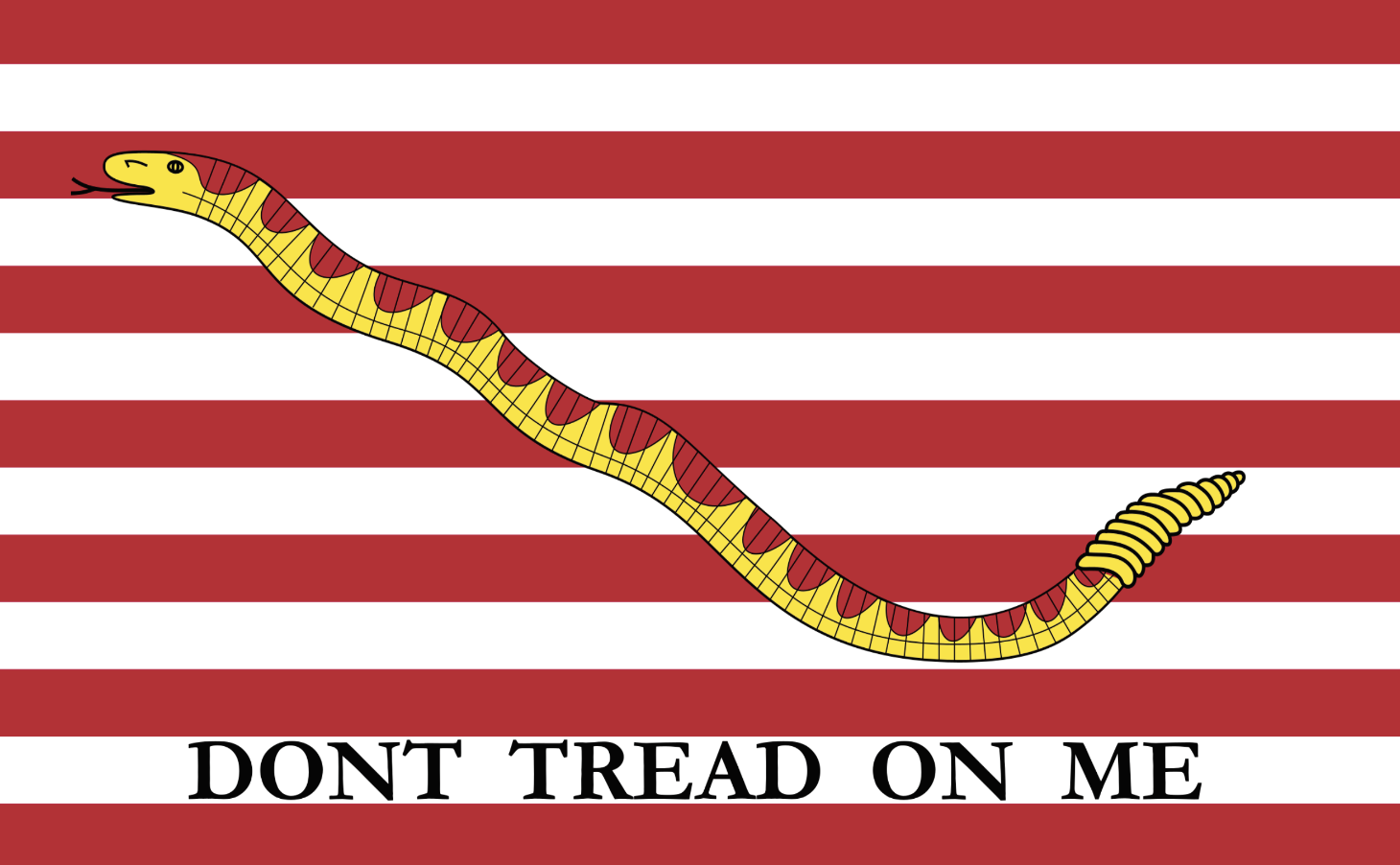
Navy Jack flags are flown from the jackstaff of commissioned Naval vessels while moored pierside or at anchor. In late 1775, Continental Navy ships were instructed to fly a striped jack flag. The exact design of the first Navy Jacks is unknown, but it could have been this design which later became the standard.
This flag consists of thirteen red and white stripes overlaid with an uncoiled rattlesnake and the motto “Don’t Tread on Me”. The rattlesnake was another popular symbol of resistance and defiance to the Crown. Another very popular flag design of the time, the Gadsden flag, featured a bright yellow background with a coiled rattlesnake and the words “Don’t Tread on Me” along the bottom.
A political cartoon was published in Benjamin Franklin’s Pennsylvania Gazette in 1754 that depicted a severed rattlesnake. Each of the thirteen segments were labeled with a colony name and the words “Join, or Die” were written underneath.
7. First Pennsylvania Rifles / 1st Continental Regiment Flag
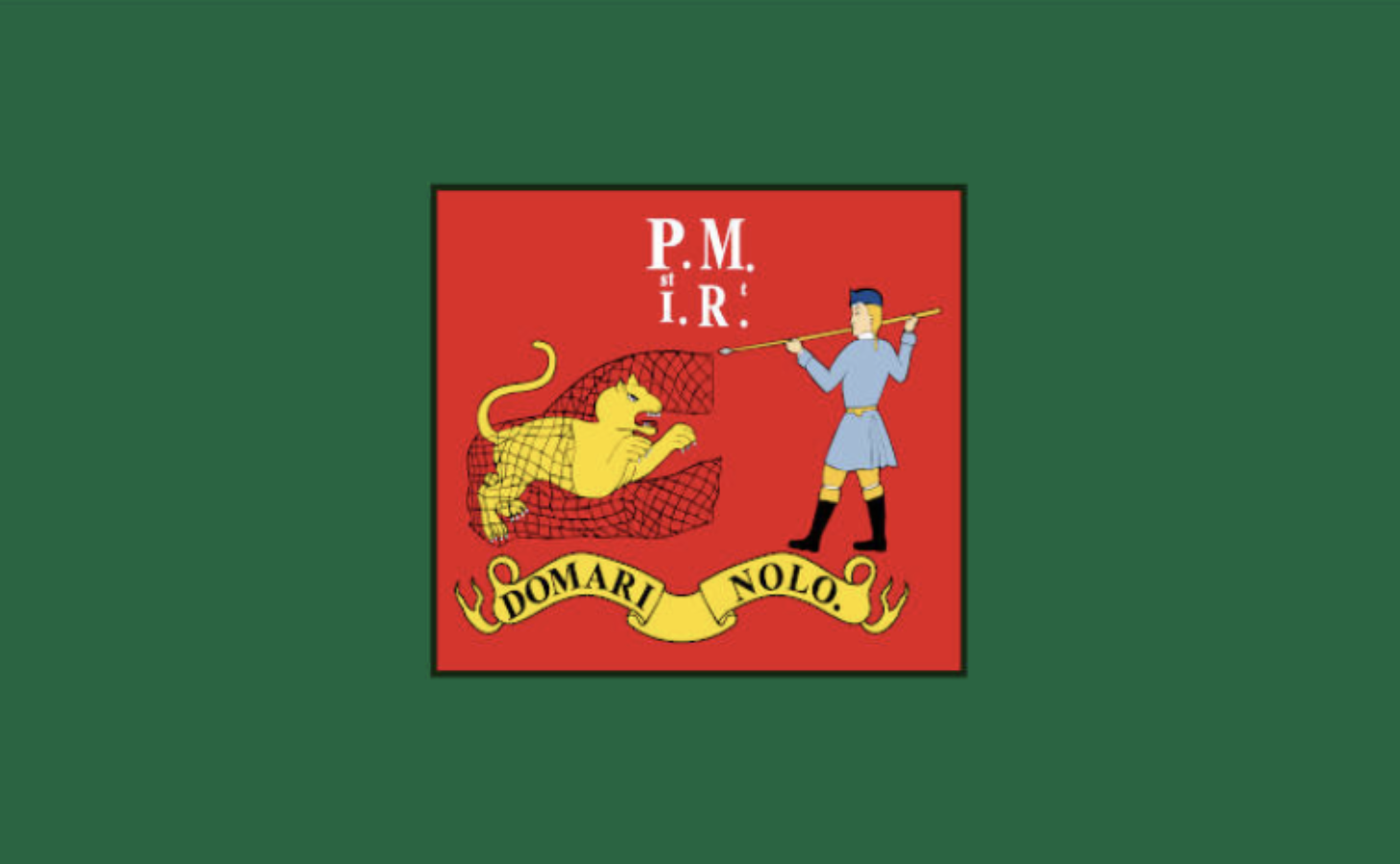
The Pennsylvania Militia 1st Regiment* saw action in every one of the original 13 colonies during the Revolutionary War. They were at the Siege of Boston (1775-76), staying behind to cover the main Army’s retreat from Long Island. They crossed the Delaware with Washington on December 25, 1776. They were at Brandywine, Germantown, Monmouth, and every major battle and skirmish all the way to Yorktown, where they witnessed Cornwallis surrender. This flag was present and flying through all of it.
This regimental flag features a deep green field with a central painted scene of a hunter with a spear, attempting to trap a tiger with nets, and bearing the Latin motto Domari Nolo which translates to “I refuse to be subjugated.
*This group was also known as Thompson’s Rifle Battalion, the First Regiment of the Continental Line, and The Pennsylvania Battalion of Riflemen.
8. Fort Moultrie Flag
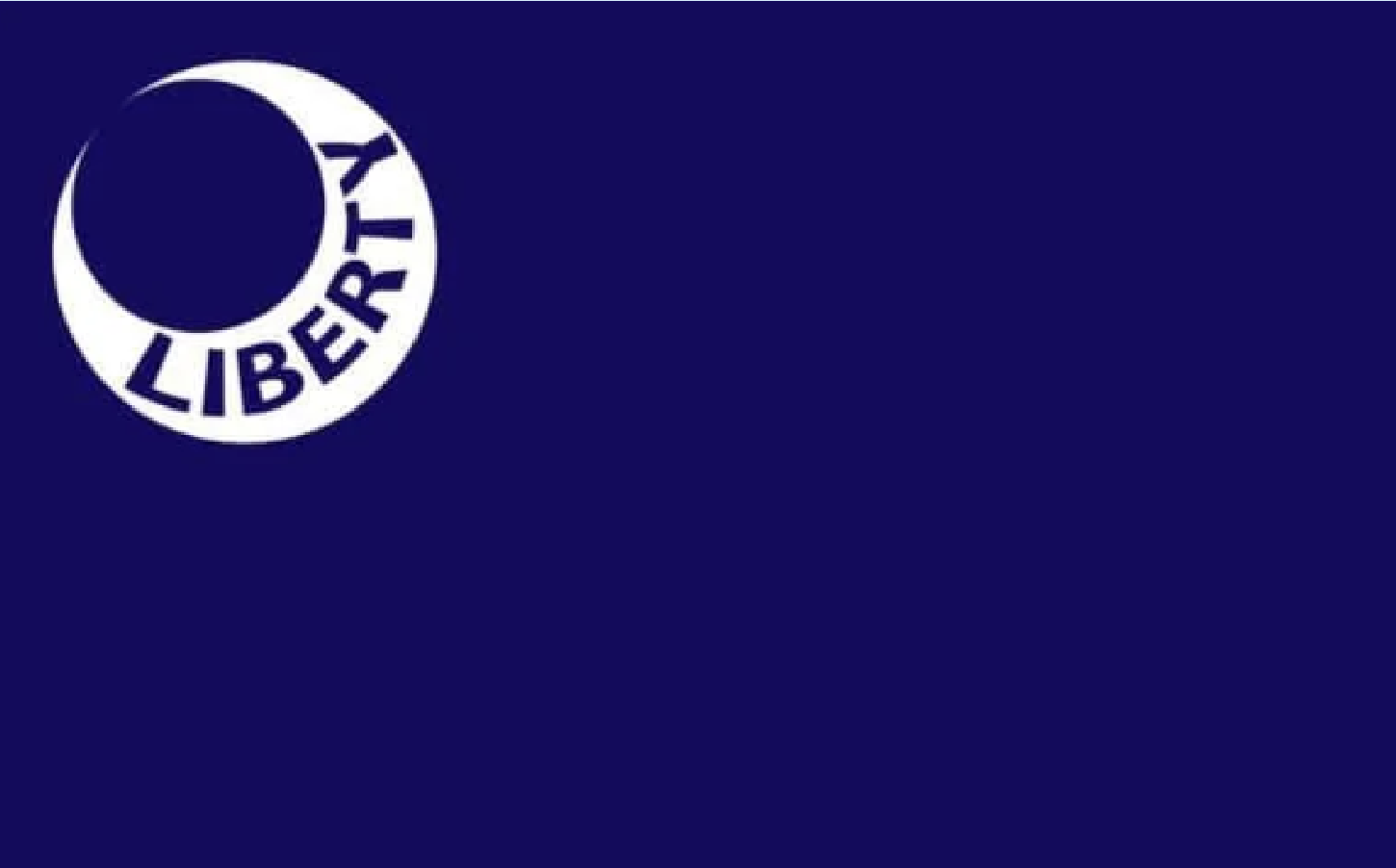
In September 1775, the 2nd South Carolina Regiment took control of Fort Johnson under the command of Colonel William Moultrie. Since there was no official flag at that time, Col. Moultrie created this flag to fly over the fort. The Moultrie Flag is considered the first American flag flown in the south,
In 1776, Col. Moultrie was stationed at Sullivan Island, in the entrance of Charleston Harbor. The British fleet bombarded the fort in June 1776, but British cannon balls bounced off the fort’s spongy palmetto log walls while American cannons devastated the British ships. This battle became the first major victory for the Americans. Later, this flag respresented the South Carolina Minutemen and also influenced the current South Carolina state flag.
9. Continental Colors / Great Union Flag
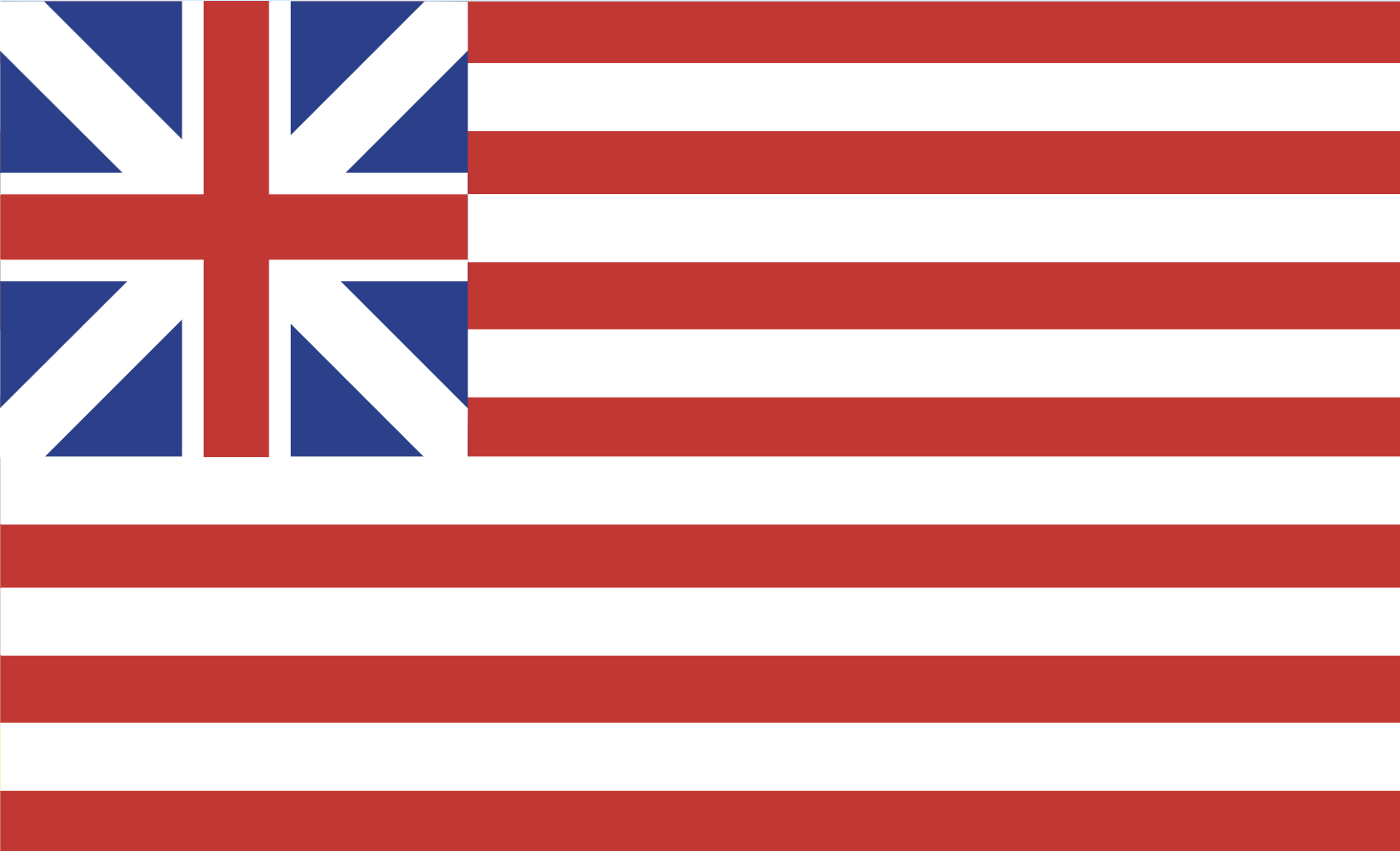
In June 1775, the Second Continental Congress voted to incorporate patriot militias into a central military, the Continental Army, and named George Washington its commander-in-chief. On July 4, 1776, Congress formalized the war, unanimously adopting the Declaration of Independence.
As 1775 drew to a close, the American colonies had divided loyalties about this uprising and Washington realized a flag may help unify the cause. Legend tells us that he approached a Philadelphia pennant maker named Rebecca Flower Young with a sketch of a flag that would be easy and fast to sew. Young only had to sew six white stripes over the red field of an existing British Red Ensign flag.
According to legend, this flag was first raised when George Washington took command of the Continental Army on January 1, 1776. After that, Washington personally paid to equip the first 1,000 soldiers that enlisted under this flag, which he called the “Great Union Flag” in letters he wrote during that time.
10. Betsy Ross Flag
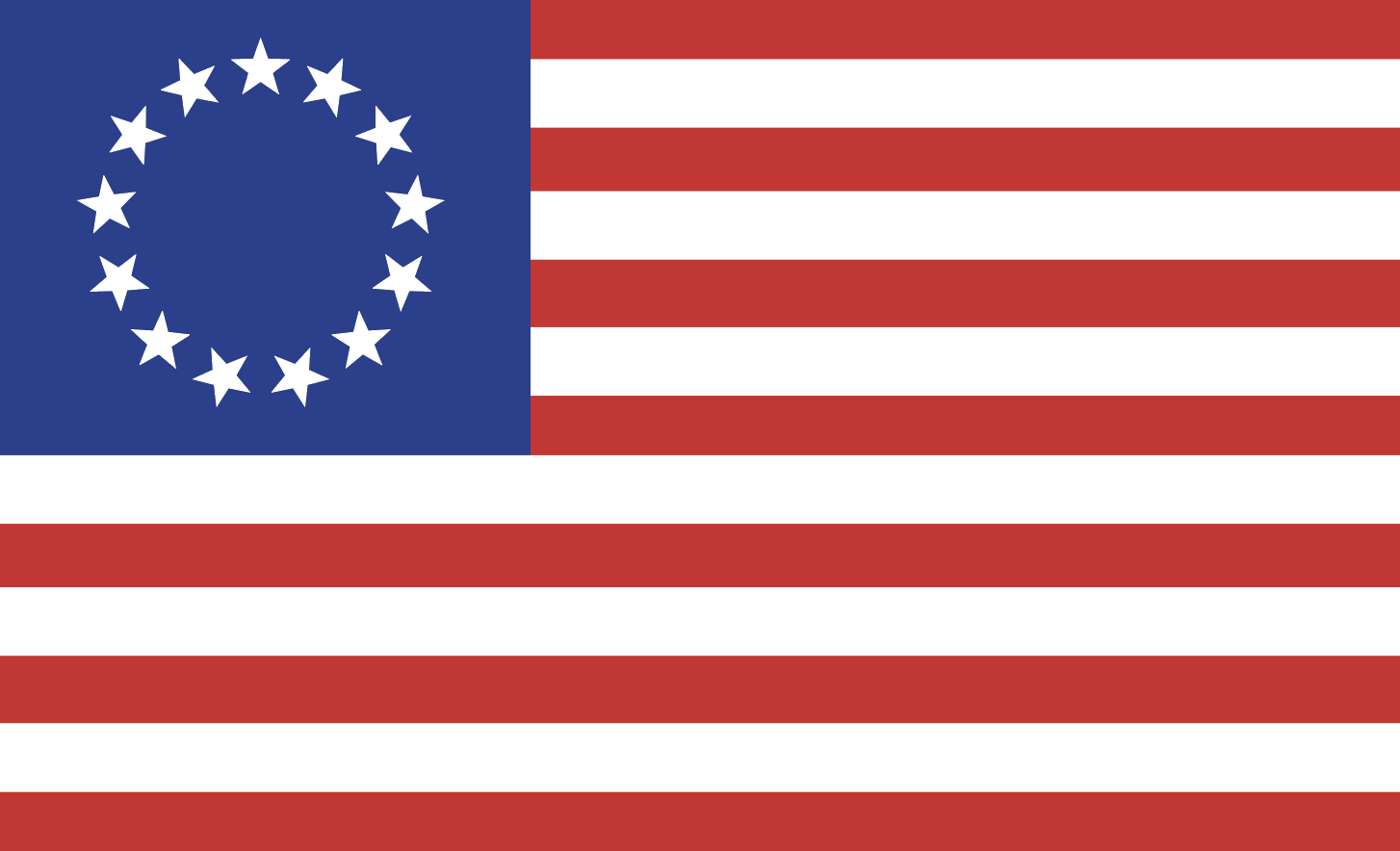
The Continental Colors Flag worked for a while, but as the 13 colonies moved towards independence it became apparent an entirely new flag was needed. John Ross had been a member of the Pennsylvania Provincial Militia and was killed when the ammunition supply he was guarding exploded in January 1776. His widow, Betsy Ross, took over running their upholstery shop (which also sewed sheets, banners, and other items). Legend says that George Washington commissioned Betsy to sew the first official American flag in June 1776.
The pattern Betsy Ross sewed, 13 stars arranged in a circle, represents equality among the colonies (with each star representing a colony). The Betsy Ross Flag also appears in John Trumbull’s “George Washington before the Battle of Trenton” painting. Trumbull received guidance in what to include in this painting from a very reliable source, George Washington himself!
11. Saratoga and Yorktown Flag
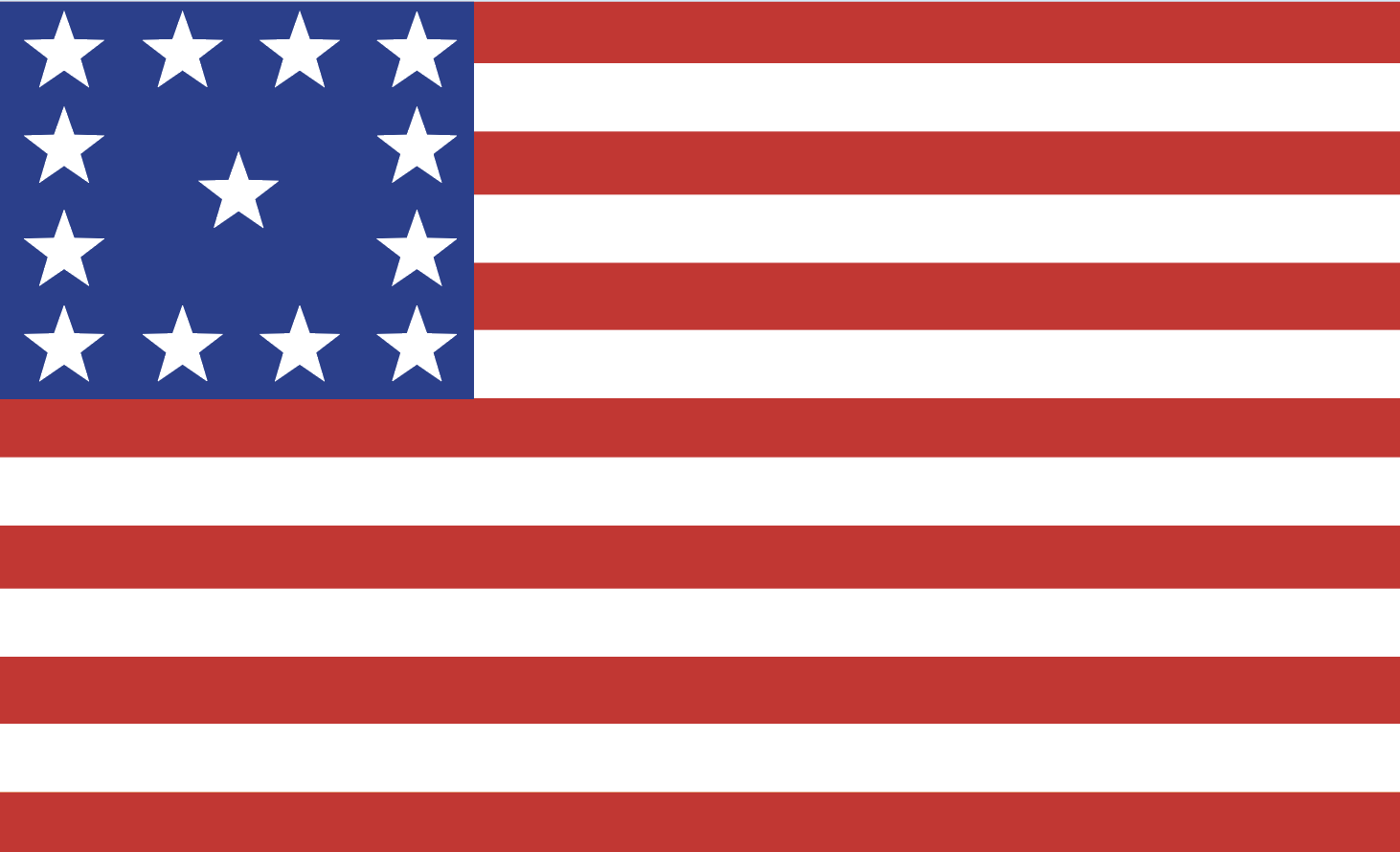
Since cameras had not been invented yet, artist drawings and paintings are important sources of information about the American Revolution. Known as the “Painter of the Revolution,” artist John Trumbull was commissioned for a number of such paintings. Since Trumbull had been an officer in the Continental Army (serving for a short time as aide-de-camp for George Washington), the assumption is that his paintings are based on personal knowledge or eyewitness accounts.
This flag design appears in several of Trumbull’s paintings, including “Saratoga” from 1777 and “Yorktown Surrenders” from 1781. Saratoga was a turning point battle, where Washington captured an entire British army group and convinced France to join the patriotic side of the conflict and send troops and supplies.
12. Bennington Flag
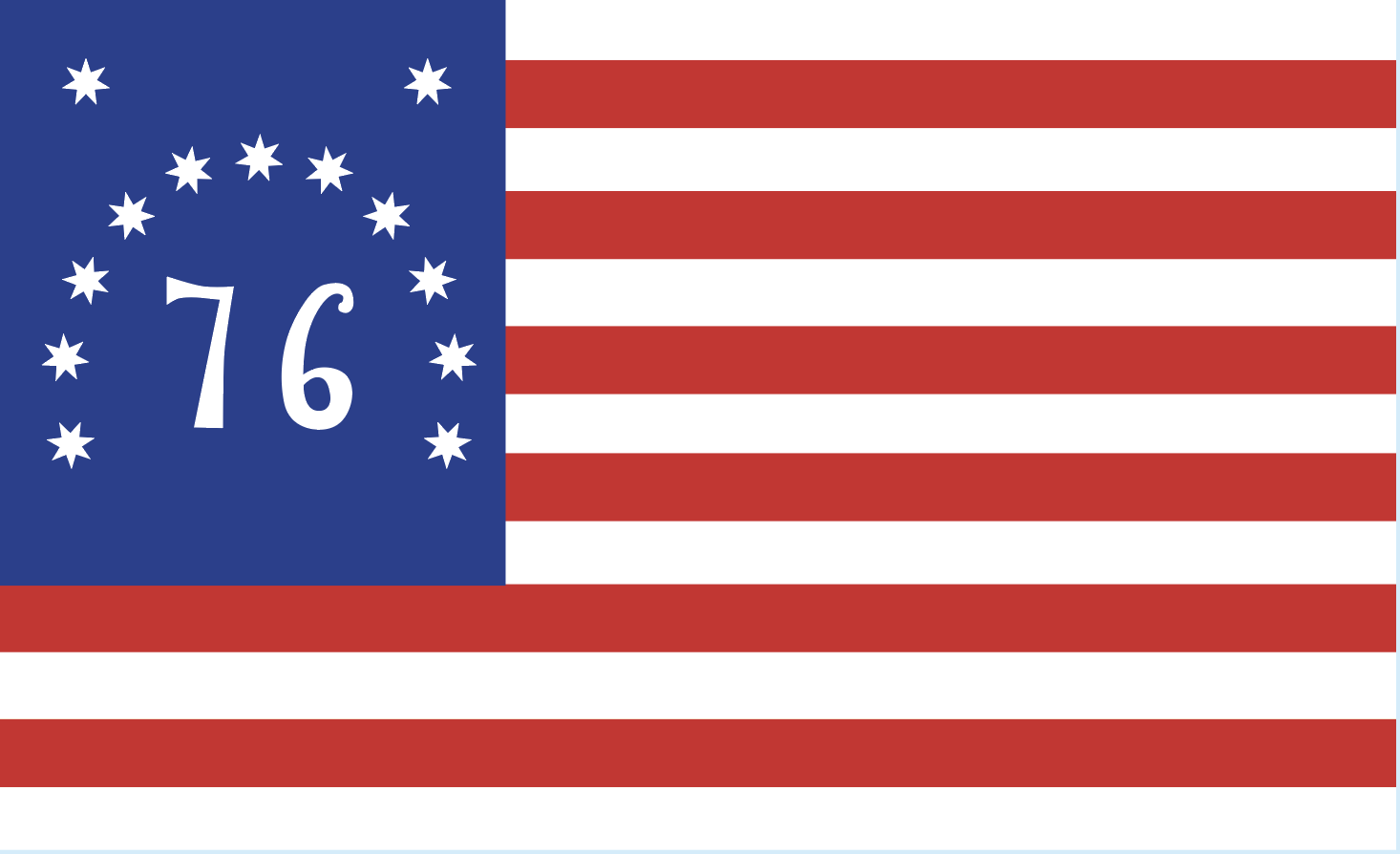
In the summer of 1777, the British made an effort to isolate New England from the rest of the United States by marching south from Canada. However, by August their supplies had run out. The British general sent a detachment to Bennington, Vermont in an attempt to capture American supplies that were stockpiled there. In what signaled the beginning of the end for the British in the north, they suffered an overwhelming defeat. The Bennington flag was flying over that supply center.
This flag follows the accepted rules of flag Heraldry with white stripes on the top and bottom. Its believed this practice fell out of fashion because white stripes on the edges show wear faster. This flag became the unofficial Flag of the Bicentennial in 1976.
13. Green Mountain Boys Flag
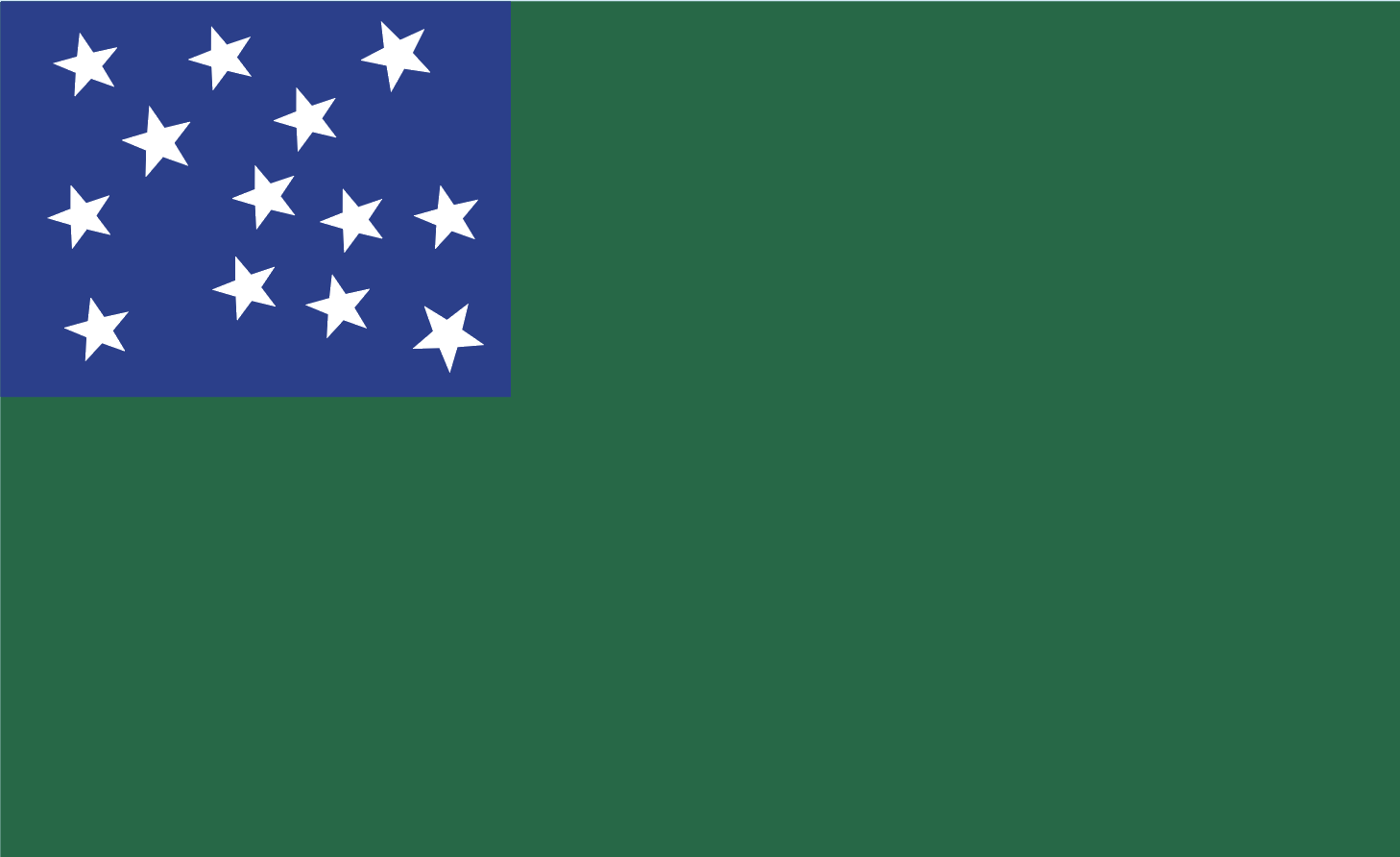
Part of the Vermont Militia, the Green Mountain Boys are best known for the capture of Fort Ticonderoga in May 1775. The captured cannon and mortars from that battle were transported to Boston Harbor and were instrumental in forcing a British retreat from there. However, no records show a regimental flag before 1777.
At the Battle of Bennington, the Green Mountain Boys regiment carried this green flag with 13 white stars on a blue canton, now the Flag of the Vermont National Guard. Better than the bright reds and whites of other regimental flags, this green flag would not give away their position in the forests where their battles were fought. As in many American flags of the time, the stars were not arranged in any type of order.
14. Washington’s Commander-in-Chief / Headquarters Flag
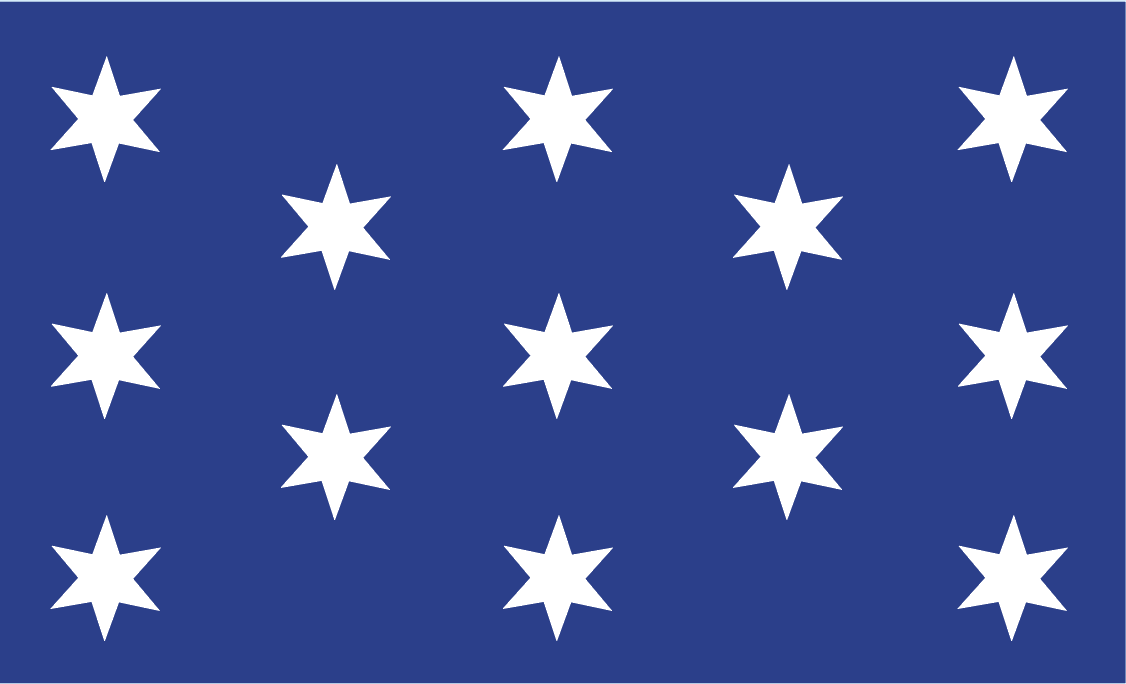
This flag has been widely called the personal flag of George Washington and reportedly flew wherever he was present throughout the Revolutionary War. However, there is debate on its authenticity because it has no hem or fringe. Some feel this “flag” could be just a canton that was cut off a larger flag.
This flag does have thirteen 6-pointed stars, like the stars that appear on Washington’s epaulettes in some of his portraits. Flags of this design can also be seen in two period paintings, the “Battle of Princeton” by William Mercer and “Surrender of Yorktown” by Louis-Nicolas van Blarenberghe (both painted from eyewitness accounts), providing further evidence of this flag’s existence.
Stars used on historic American flags have between 5 and 8-points, with straight sides. Stars with straight sides are called “mullets” while a “estoile” has wavy sides. The stars on the American flag symbolize a “new constellation,” a new nation breaking free from colonial rule. Other countries seeking independence have adopted this symbol for their own flags. Stars with 6-points are most common in British heraldry, so Washington sketched those for our first flag. However, legend says that Betsy Ross demonstrated how much easier it was to cut a 5-pointed star, so they went with that design. It wasn’t until 1912 that 5-pointed stars became the official star on our flag.
15. Brandywine Flag
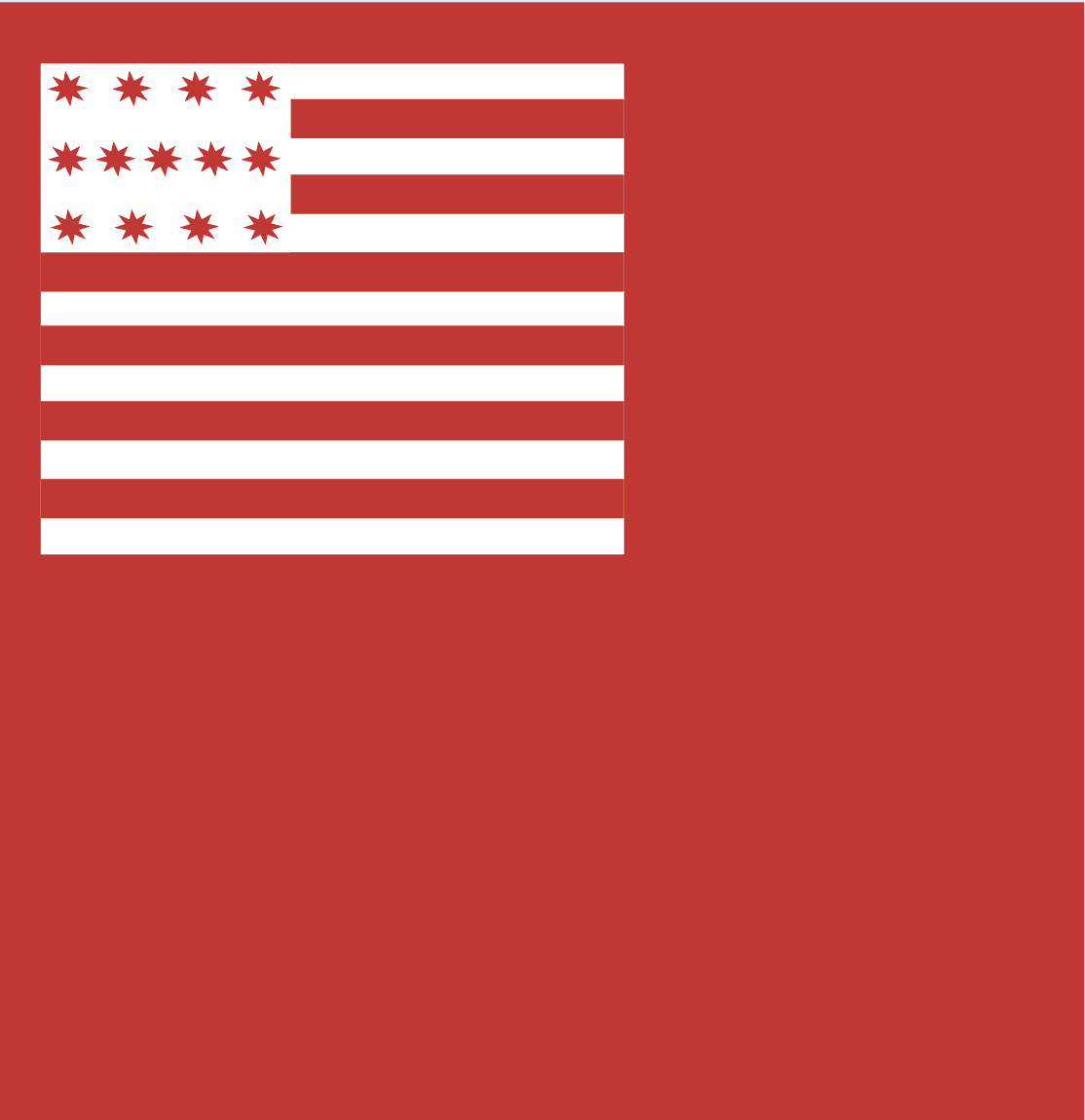
On September 11, 1777, the British were advancing on Philadephia, the American capital, so the patriots set up an ambush along their route at Brandywine Creek. However, the British found out and sent a diversionary force to the American front while stealthily moving the majority of their forces upstream. There they safely crossed the creek and flanked the American troops. Washington realized his men were in jeopardy and withdrew, which allowed the British to take Philadelphia.
This Pennsylvania Militia Flag contains the national flag in its left upper corner and is considered the first “Stars and Stripes” to see action in a battle.
16. Fort Mercer Flag
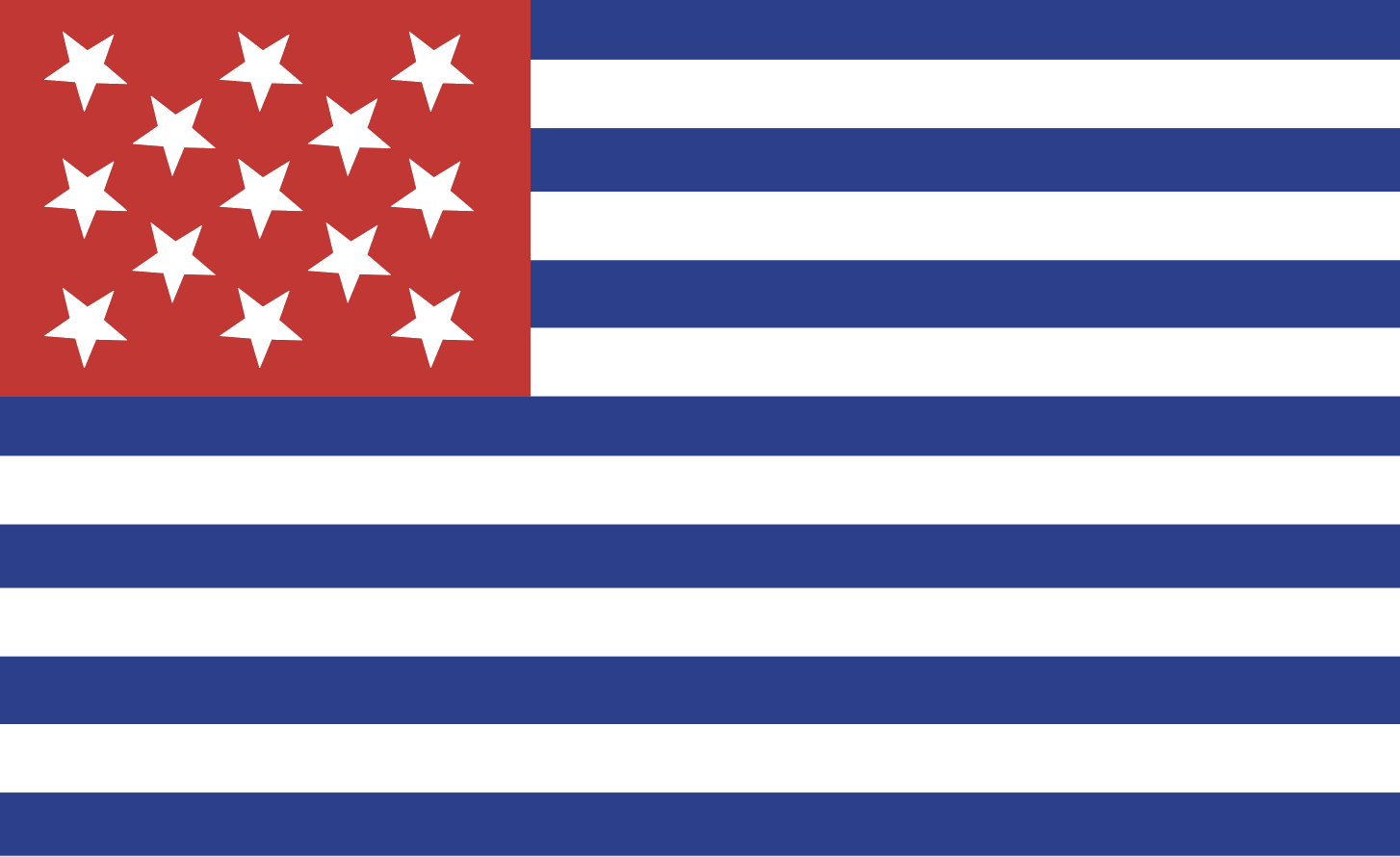
In 1777, two forts were constructed on opposite banks of the Delaware River; Fort Mercer in New Jersey and Fort Mifflin in Pennsylvania. The Americans knew that if they could hold both forts that the British army (which was in Philadelphia after Brandywine) could not be re-supplied or communicate with the outside world. The British general sent 1,200 Hessian mercenaries (Germans hired to help the British) to attack Fort Mercer, landing them by ferry three miles from the fort. The small American force of only about 400 soldiers not only held the fort but caused the Hessian force nearly fifty-percent casualties.
This unusual flag was flown at Fort Mercer. While it has the 13-stars and stripes, for some unknown reason the normal red and blue colors were reversed.
17. Fort Mifflin Flag
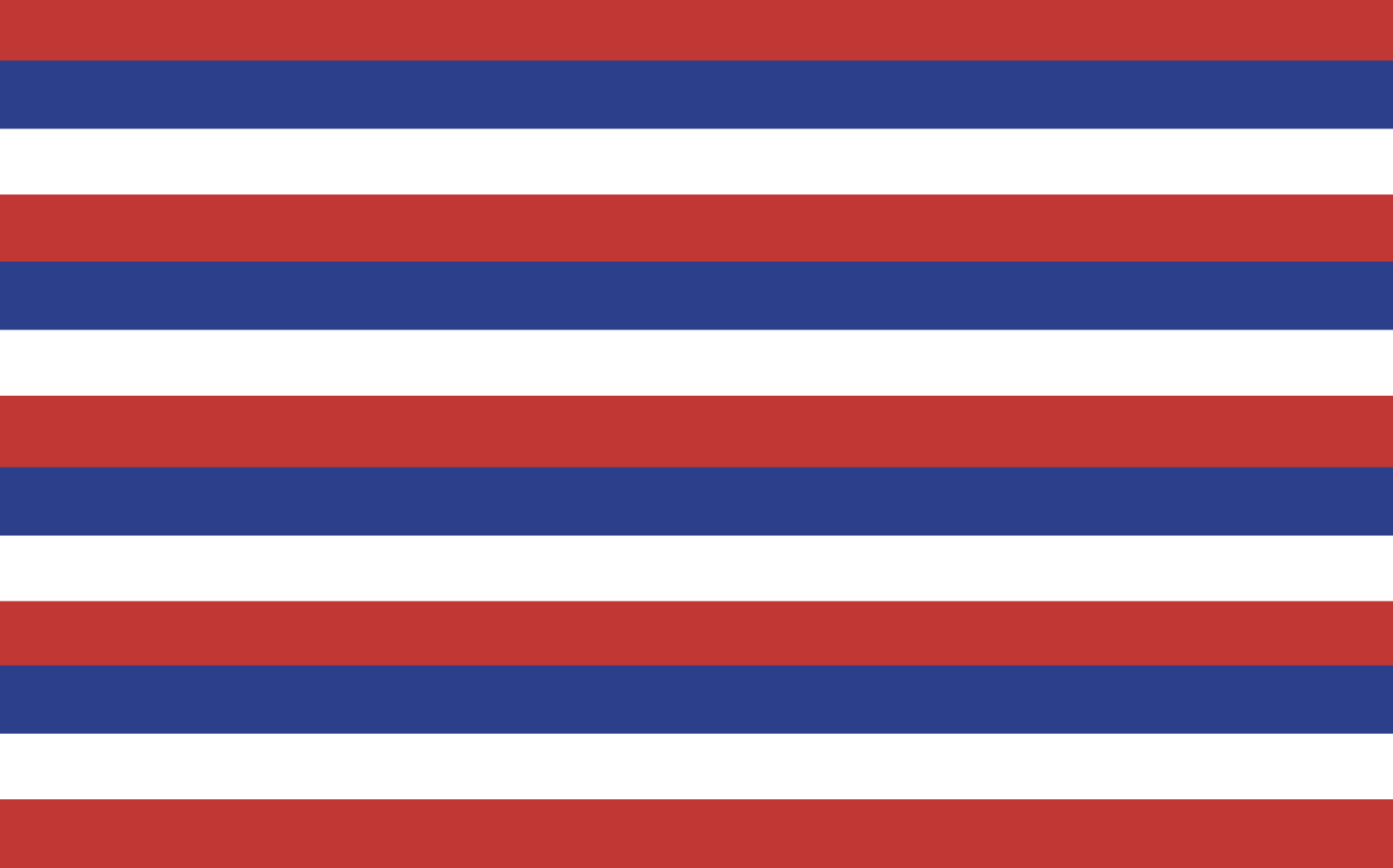
After also trying and failing a direct assult against Fort Mifflin, the British put it under siege. Over 10,000 cannonballs were shot at the fort, the largest bombardment in American history (up to that point). During this barrage, the flag was shot down and two soldiers gave their lives to raise it once more. When the American commander made the decision to abandon the fort, he left the flag flying, confusing the British. They didn’t realize the Americans had left until after they had reached the safety of Fort Mercer. Later that month, the Americans abandoned Fort Mercer too, giving the British freedom to navigate the Delaware River.
The Fort Mifflin flag was originally a Continental Navy Jack flag. Fort defenders borrowed the flag from the Navy, because it was in the vicinity of the Delaware River forts and was the only American flag the soldiers could secure at the time.
18. Hopkinson Flag (6-pointed stars)
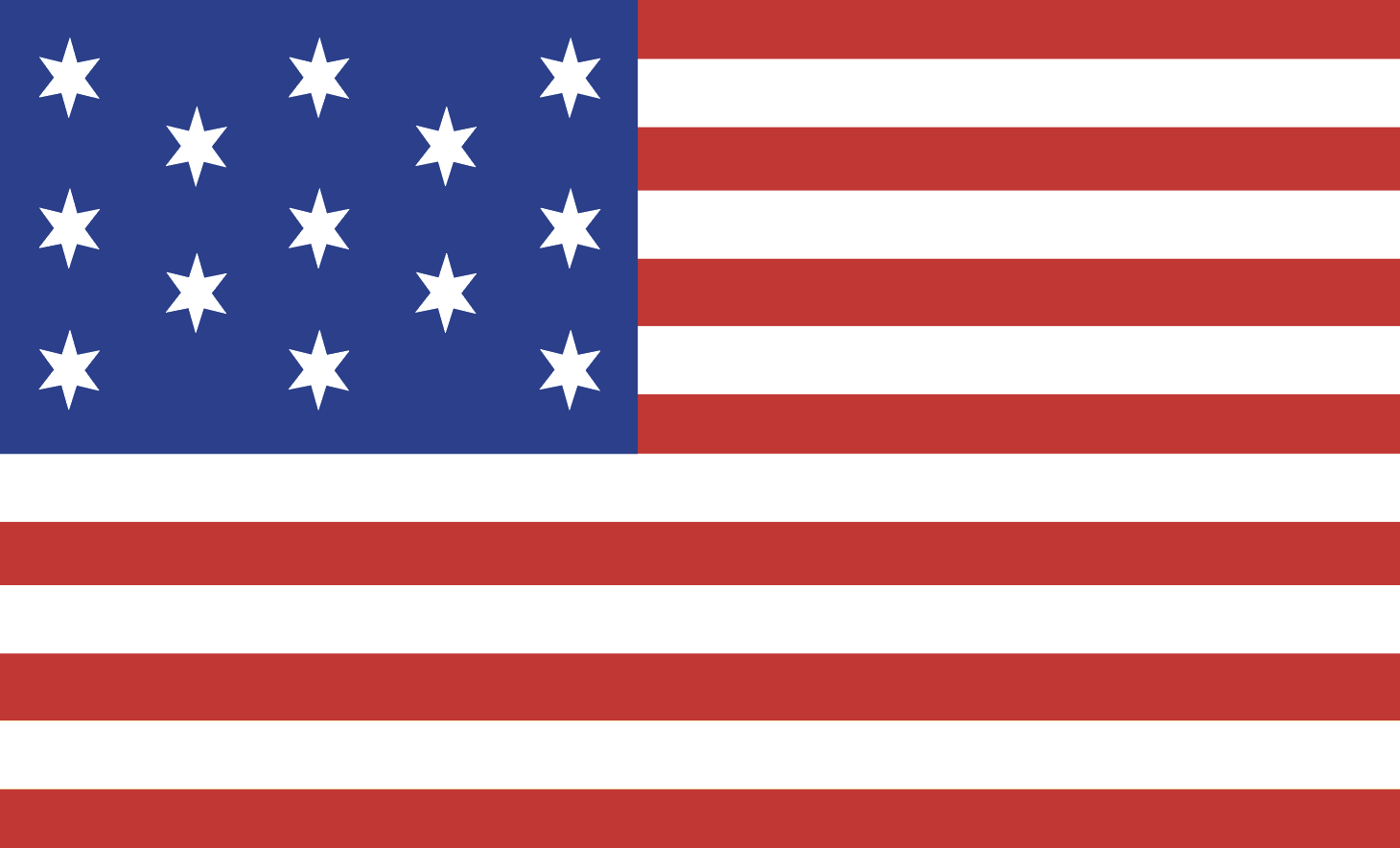
The Flag Act of 1777 was passed by Congress on June 14, 1777, detailing that 13 alternating red and white stripes and a blue field with white stars should be our flag. As a result, June 14 was chosen to be Flag Day in the United States.
Many give credit for the design of the first official Stars and Stripes flag to Francis Hopkinson, a gentleman who dabbled in the arts and who joined Congress just in time to sign the Declaration of Independence.
In May 1780, Hopkinson sent an invoice to Congress for a “quarter cask of the public wine” as payment for designing both the Seal of the United States and the first Official Flag. There is debate as to which flag Hopkinson designed. Regardless, his invoice was denied because Congress declared “the Public is entitled to these little acts of assistance from gentlemen who enjoy a considerable salary under Congress.”
19. First Official Navy Flag (5-pointed stars)
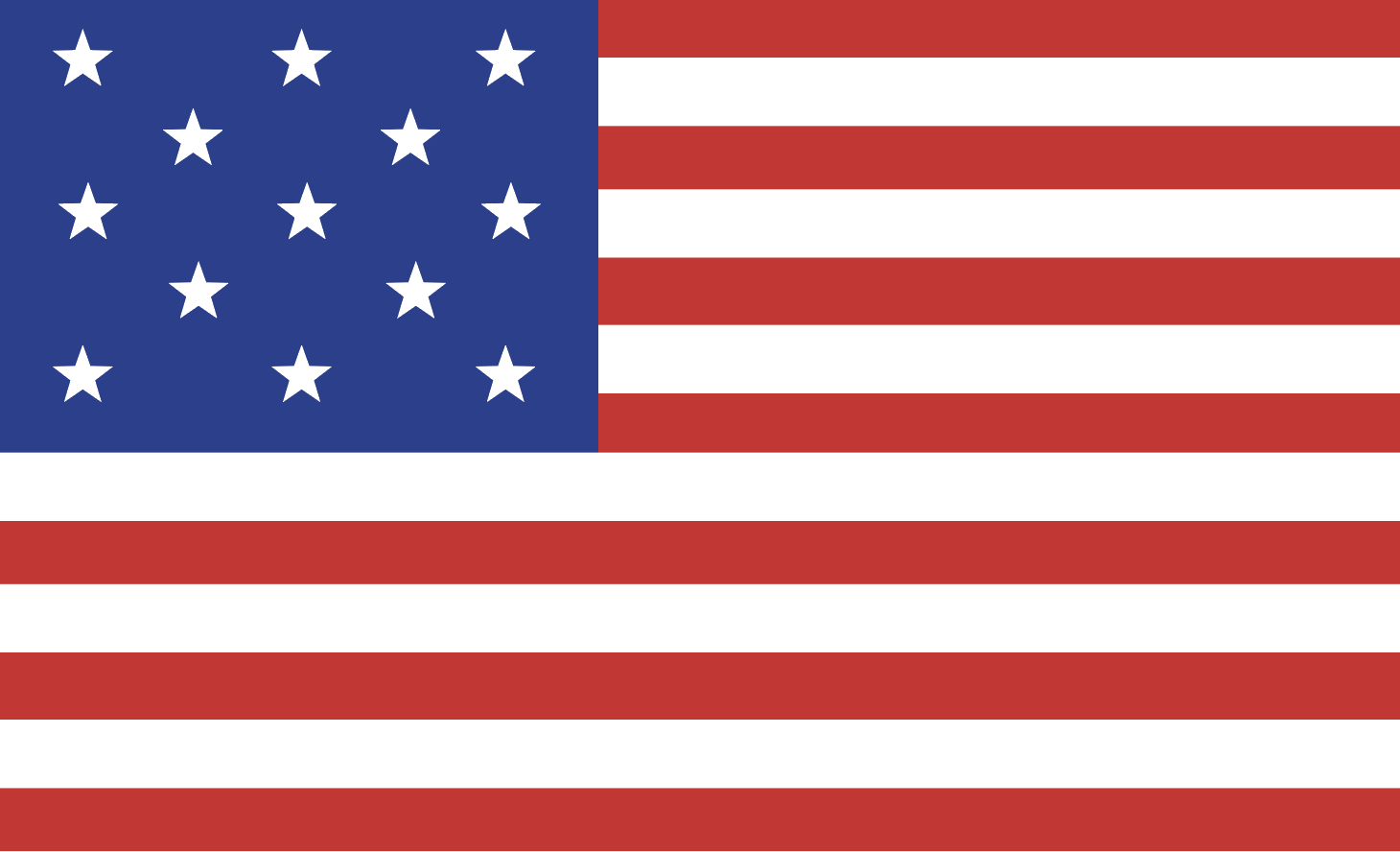
Captain John Paul Jones plundered many British merchant ships off the coast of England. To the British, he was a pirate. To the US, he was a hero and a patriot.
On February 14, 1778, Capt. Jones, in command of the U.S.S. Ranger and flying this flag, became the first American officer to have an American flag recognized by a foreign power. The salute exchange occurred with a French fleet’s flagship in Quiberon Bay, France. Earlier that month, the French king had secretly signed treaties of commerce and alliance with the United States.
20. Monmouth Flag
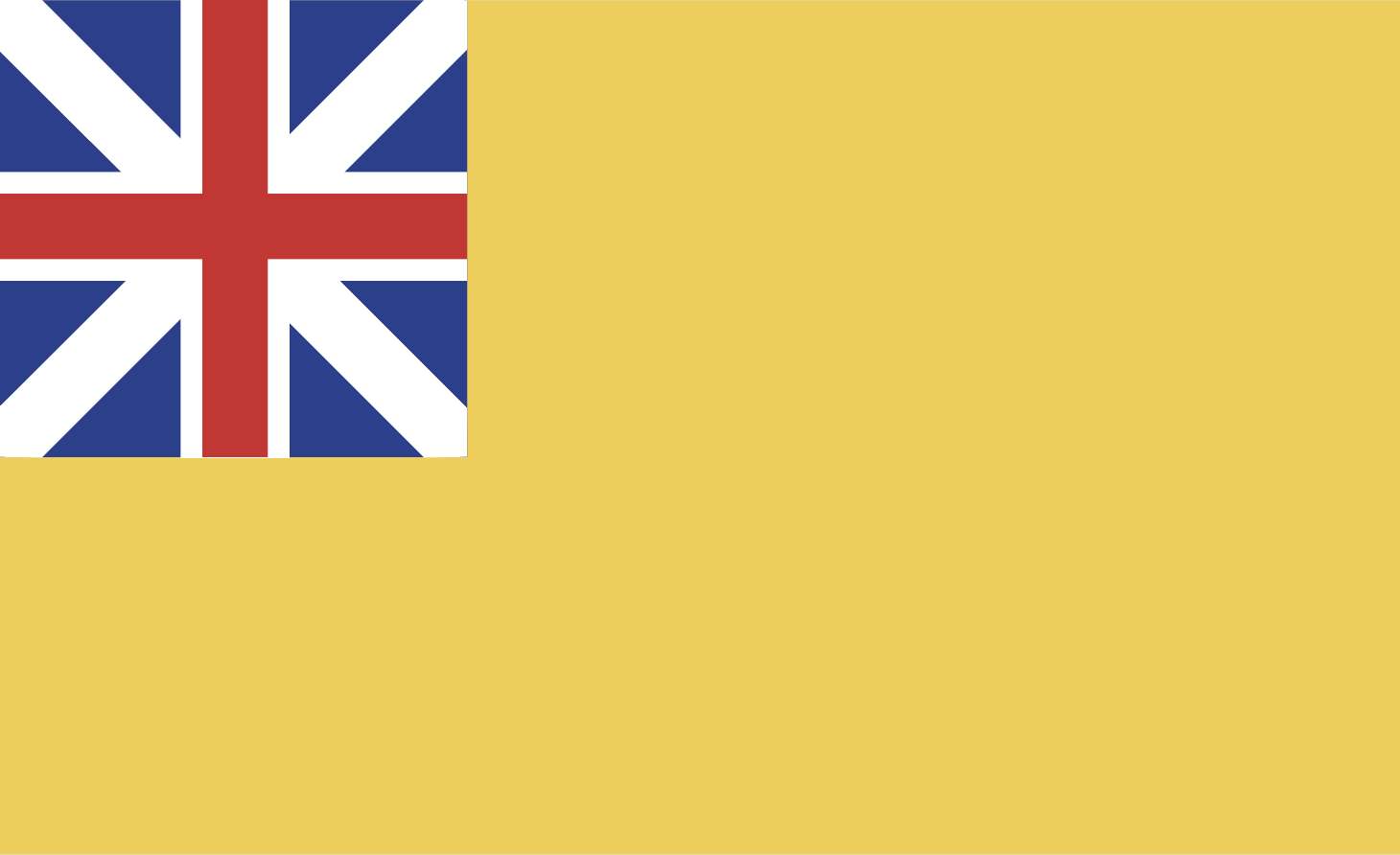
The June 1778 Battle of Monmouth is known as the longest one-day battle of the war. As the British evacuated Philadelphia and marched toward New York, Washington intercepted them and held the line until the British withdrew during the night. While the battle was a tactical draw, it was an important morale victory for the Americans, demonstrating improved discipline following new training they had at Valley Forge.
Monmouth is famous for extreme, near-100-degree heat, which caused more casualties (from heat exhaustion) than the actual combat. During the battle, Mary Hays famously brought water to the soldiers of her husband’s unit, earning her the nickname “Molly Pitcher”. When her husband, William Hays, was either wounded or fell from heat exhaustion, she took his place at his cannon for the remainder of the battle. She later received a veteran’s pension from the state of Pennsylvania.
This story symbolizes the bravery of women in combat during the American Revolution, many of whom helped on battlefields or in camp life.
21. George Rogers Clark Flag
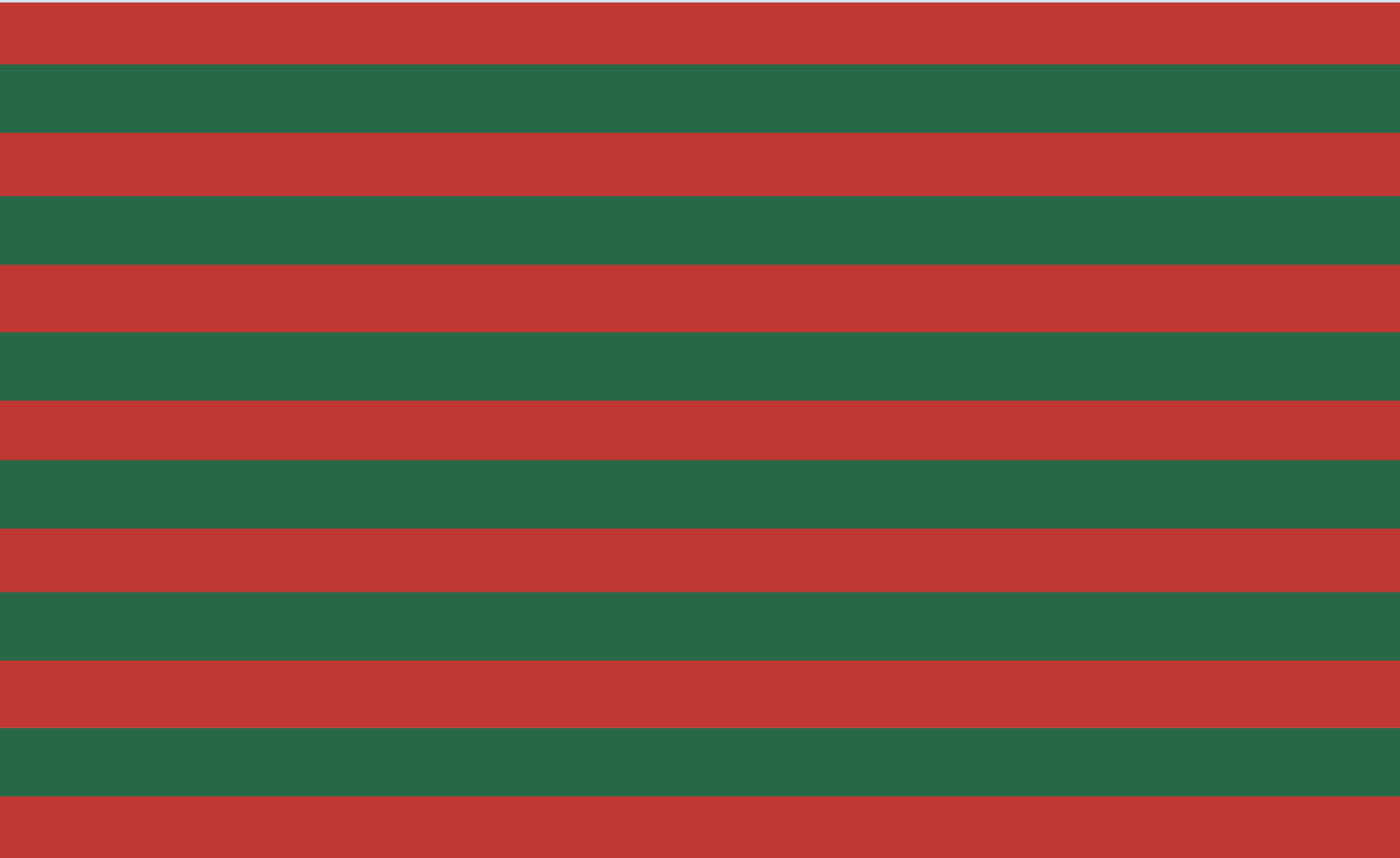
Fort Sackerville was a British outpost located in the frontier town of Vincennes, Indiana. This red and green striped flag is historically associated with General George Rogers Clark during his effort to capture the fort in February 1779. Led by Clark, American troops left Kaskaskia, Illinois, and marched for 18 days over a distance of 180 miles, through very wet terrain that ranged from a few inches to shoulder-high water. The men arrived at the fort wet, weak from hunger and exhaustion, but also in the mood to fight. After a day-long siege and a brutal show of military force, the outpost unconditionally surrendered.
Following Clark’s victory, the region northwest of the Ohio River was named Illinois County. Three years later, Congress passed the Northwest Ordinance, renaming the area the Northwest Territory.
22. Texel Flag
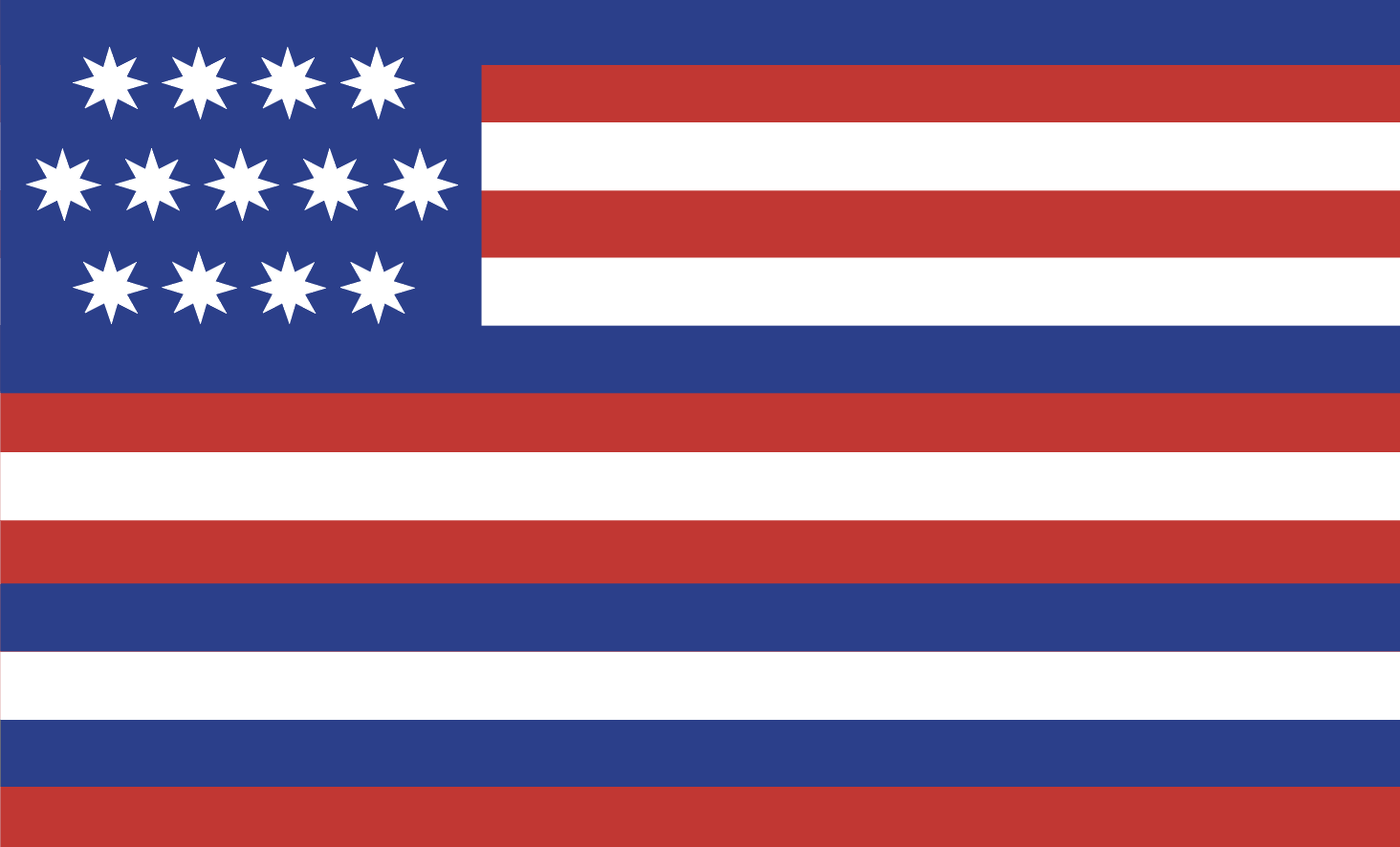
Its said that Benjamin Franklin, who was ambassador to France in 1779, mistakenly informed the French that the American flag had red, white, AND blue stripes. The French court painted what they thought was the American flag and sent this image to numerous European ports. This action would allow the new American flag to be recognized by everyone, including the Dutch harbor of Texel.
On the night of September 23, 1779, the most famous sea battle of the American Revolution took place. It was between John Paul Jones flagship, the Bonhommie Richard (named in honor of Benjamin Franklin’s “Poor Richard’s Almanac”) and another American ship, the Alliance, against the British Serapis. During the battle, it looked the the British would win when the Bonhommie Richard was sunk. As it was sinking, the British capitan allegedly asked Jones if he wanted to surrender, to which Jones famously replied, “I have not yet begun to fight!”
Jones’ crew fought in brutal hand-to-hand combat and managed to take the British ship. Jones then sailed into Texel harbor, where the badly damaged Serapis was given to the French. The harbormaster showed Jones the painting of Franklin’s version of the American flag and Jones had one sewn and raised on the Alliance. It was undoubtedly a fitting sight to see this flag return to America under Franklin’s Flag.
23. Cowpens Flag
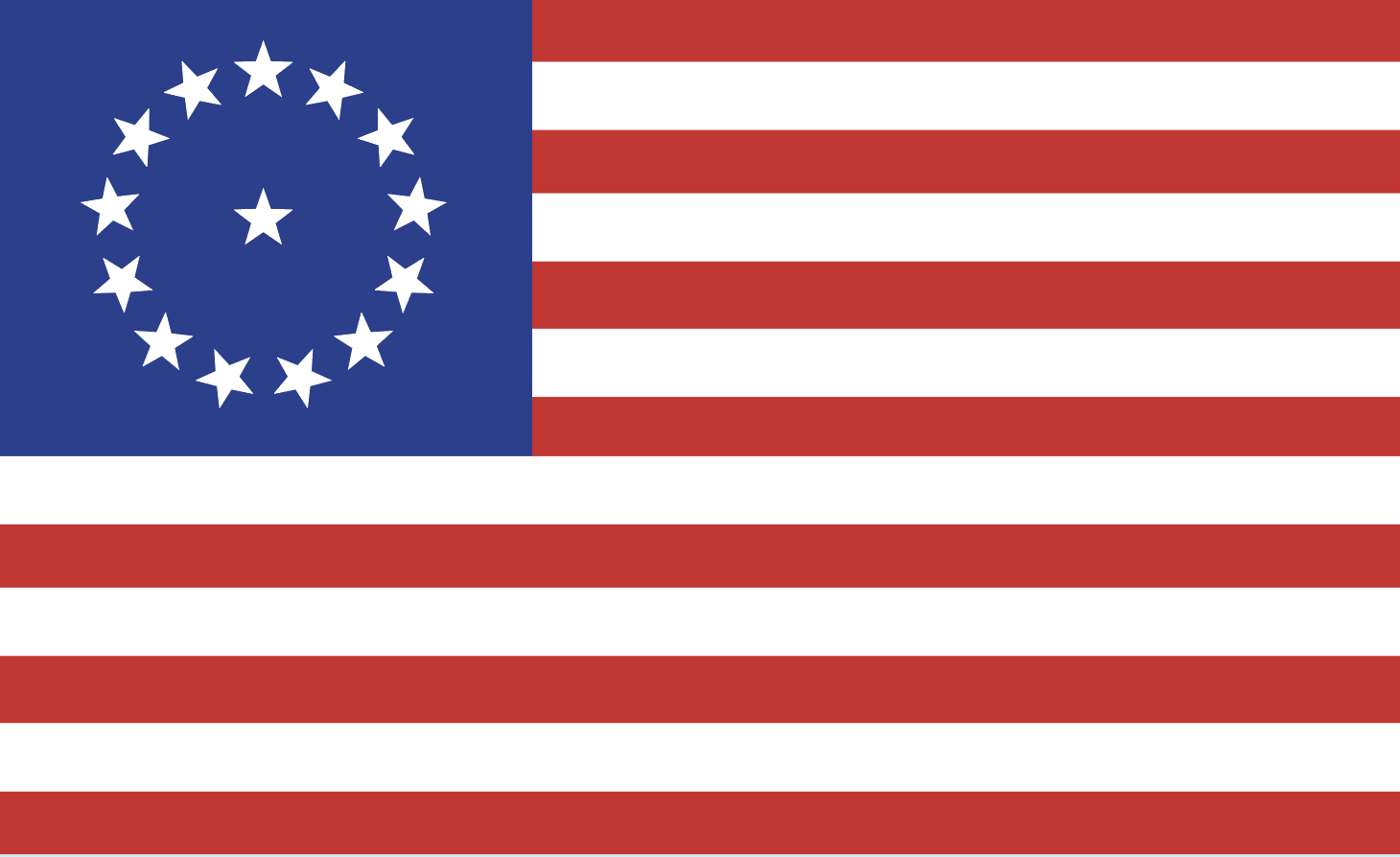
With American troops fighting well in the north and facing a stalemate there, British troops shifted their focus to the American south. In the south, the British thought they had supporters, and with them, victories that would be easily won. While they did have allies, they also had enemies, and on January 17, 1781 the Americans demonstrated that fact with a decisive victory at the Battle of the Cowpens, South Carolina. The British lost 868 men out of 1,150, while the Americans lost only 149 men out of 1,065.
After the Philadelphia campaign of 1777, British Lieutenant General Charles Cornwallis had returned to England, but after Cowpens he was recalled to America. After landing, Cornwallis was chased by the American Army across the Carolinas. In an effort to move faster, Cornwallis ruthlessly burned supply wagons and relentlessly drove his troops.
24. Guilford Courthouse Flag
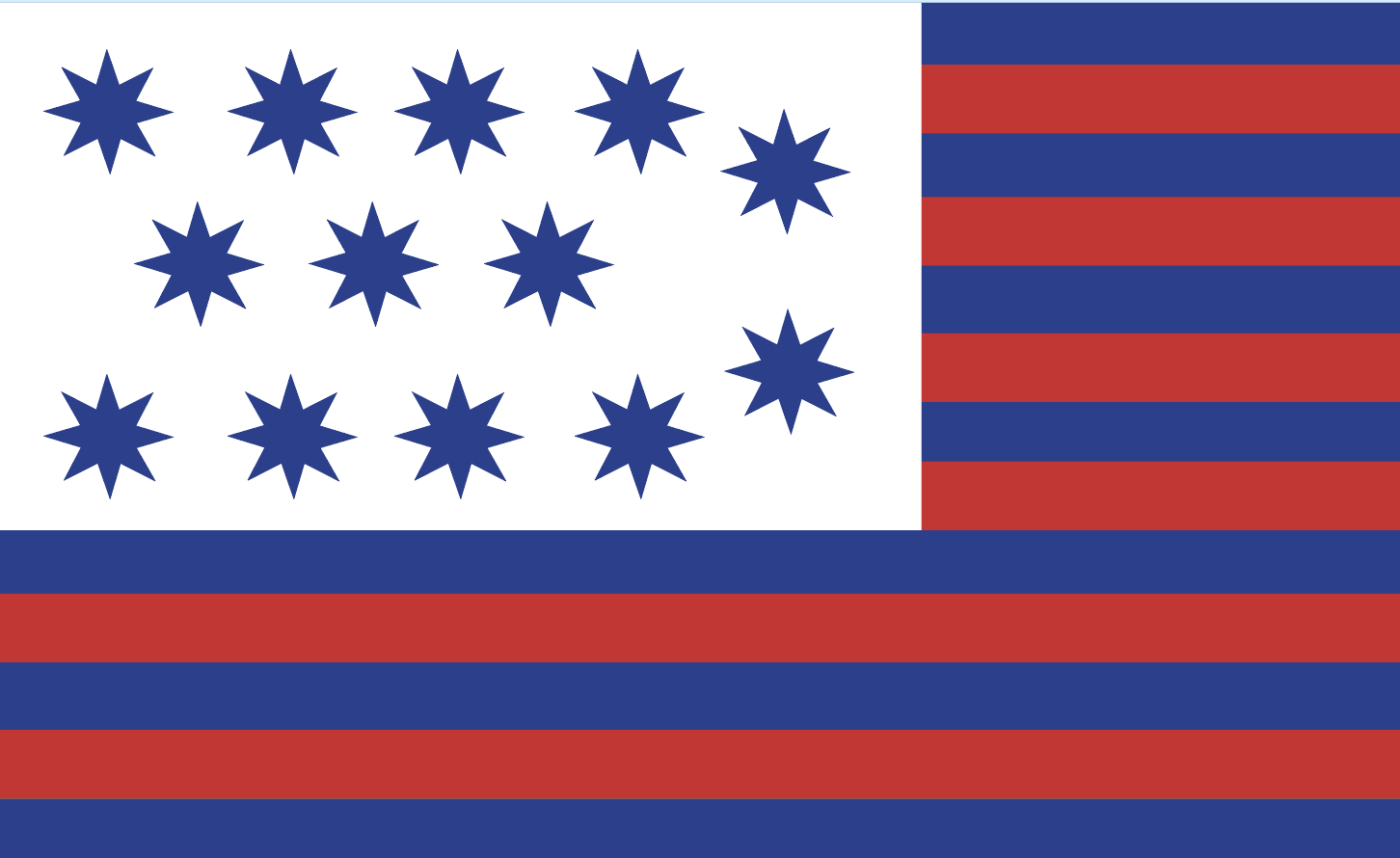
One of the bloodiest battles of the war took place at Guilford Courthouse, North Carolina, on March 15, 1781 in a battle that lasted only hours. The 4,400 American troops formed three lines of defence agains 2,385 British troops. After the battle, 1,310 Americans and 532 British had lost their lives and many more were wonded.
The British were known to stubbornly hold their ground, regardless of the cost. Although the battle was won by the British, their troops suffered catastrophic casualties. “Victories” like this followed Cornwallis as he moved his troops to the Yorktown, Virginia peninsula. From there, he planned to transport his troops to New York for the winter, and re-engage the American troops in the spring.
Tradition tells us that this regimental flag was raised over the Guilford Courthouse. This unique flag, with its elongated canton, 8-pointed stars, and blue and red stripes was never intended for use as a national flag. It was common practice for military regiments make uniquely identifiable flags to carry into battle, flags that featured common American symbols such as stripes and stars.
25. Bauman Yorktown Flag
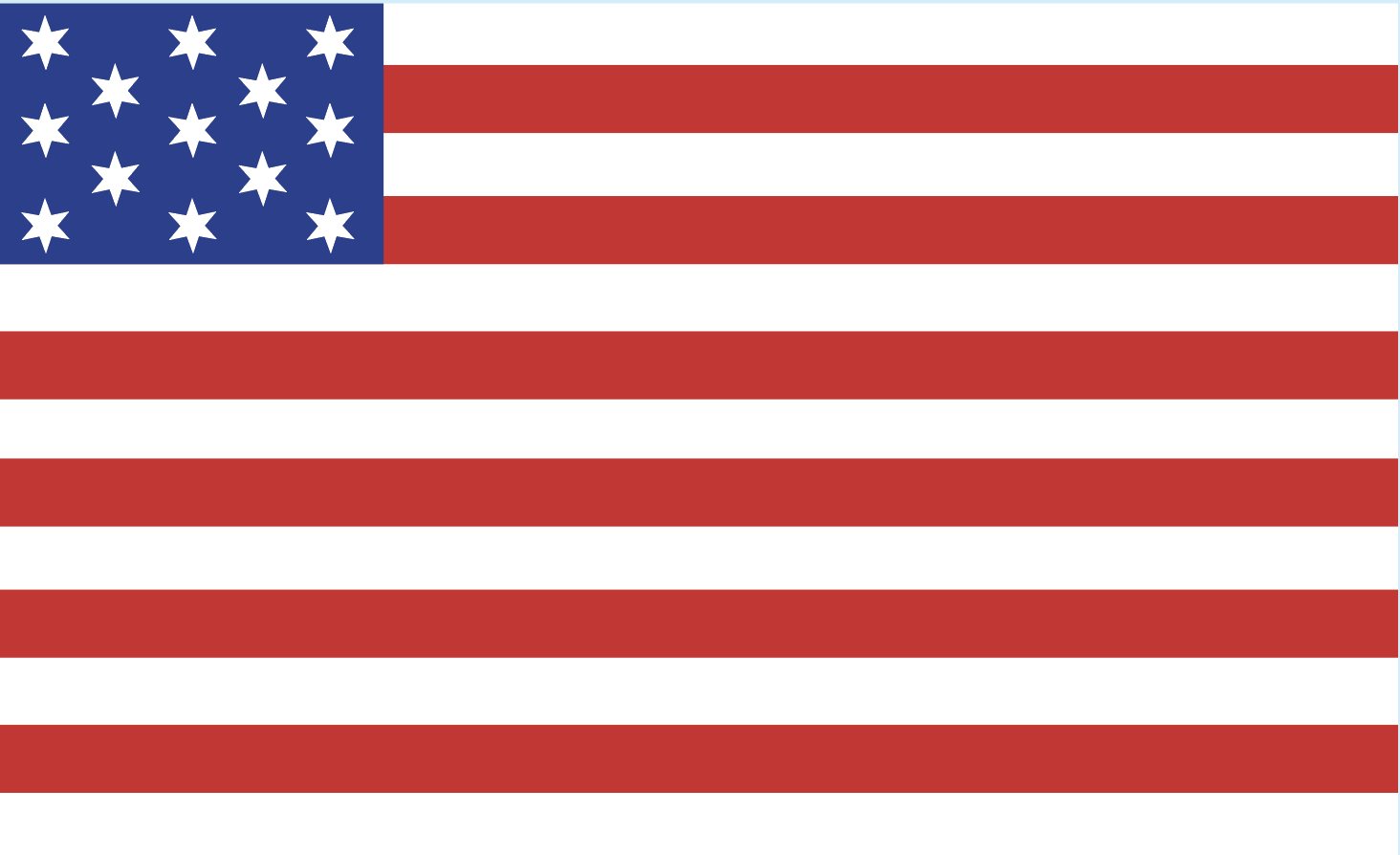
Cornwallis was ready to meet the Britsh Navy in late September 1781 at the Yorktown peninsula to resupply his 9,000 men and transport them to New York. He didn’t know his ships were being blocked by the French Navy and Washington was on his way with 19,900 troops from the north to surround the city. In a siege that lasted three-weeks it became the final major land engagement of the Revolutionary War. Its estimated that the British suffered over 8,500 casualties while the Americans lost less than 400. Cornwallis surrendered to Washington on October 19, 1781.
The Treaty of Paris was signed in 1783 after two years of skillful diplomacy, finally securing America’s independence. Cornwallis did not attend the signing. Major Sebastian Bauman from the 2nd New York Artillery Regiment carefully surveyed the terrain and battle positions at Yorktown, where he was present, and drew a map with this flag pictured. This map was later engraved by Robert Scot of Philadelphia and published. Notice the white stripes on top and bottom.
26. Simcoe Yorktown Flag
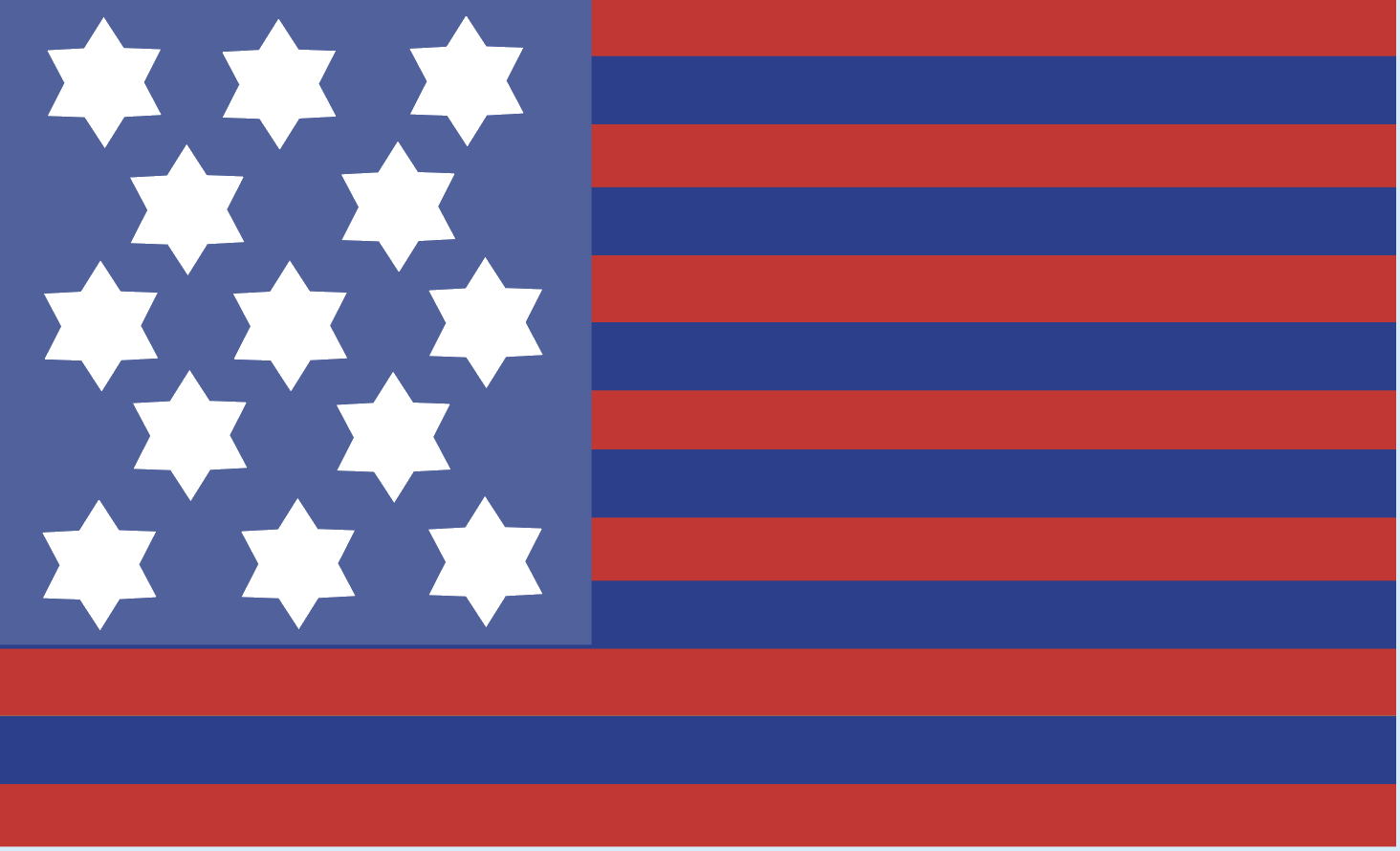
Some believe that the sun played a role in the way this flag was perceived by Lieutenant Colonel John Graves Simcoe in his painting “The Battle of Yorktown.” As it flew above the American troops, Simcoe viewed it from across the river, where he was in command of the British Queen’s Rangers. From his position, the sun was behind the flag, which probably resulted in the unique color scheme portrayed here. Simcoe later became Upper Canada’s first lieutenant governor.
27. United States-French Alliance Flag
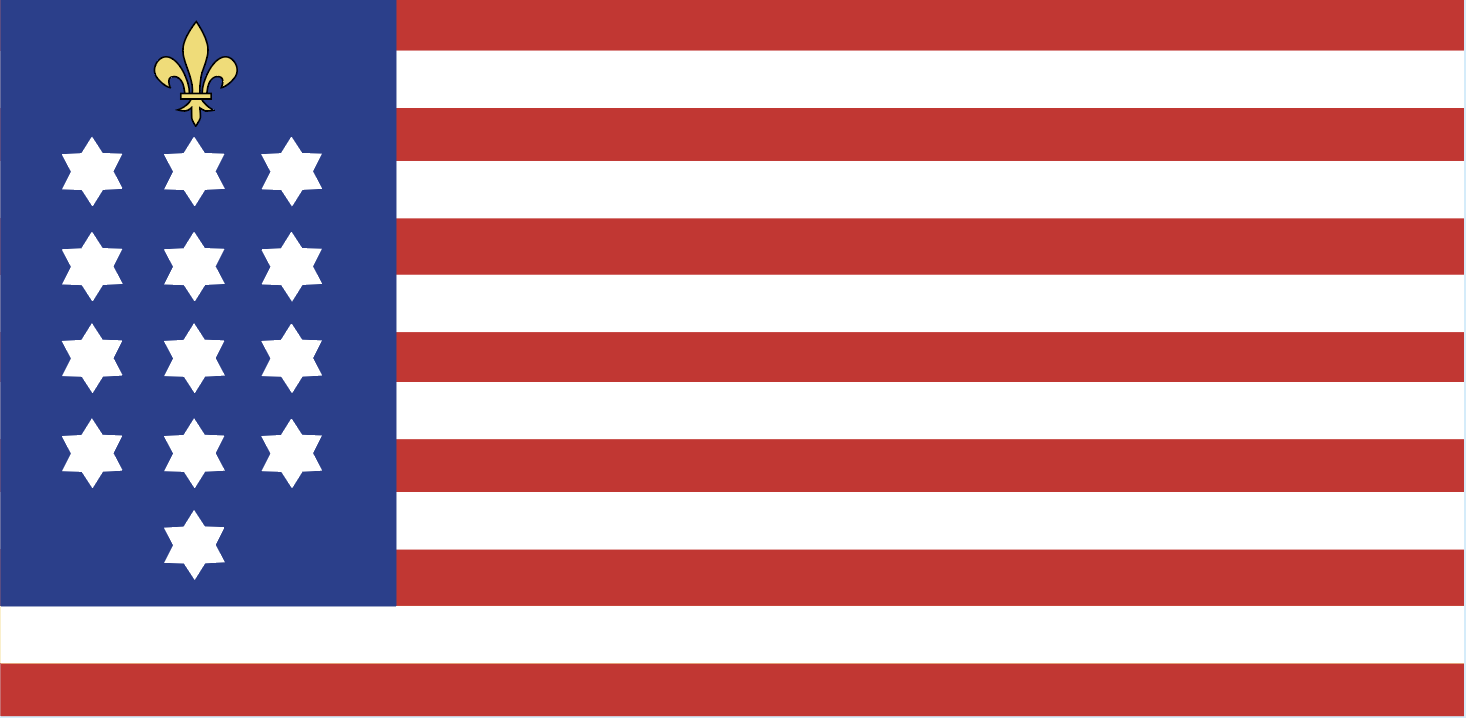
To celebrate the end of the Revolutionary War in 1781 and to honor the help of the French, a special U.S. flag was produced. French contributions included supplying the Continental Army with 90% of its gunpowder, weapons, and uniforms; providing millions of dollars in loans; and deploying over 12,000 soldiers and 63 warships to fight alongside American forces,.
The flag was comprised of 13 red and white stripes and a canton that was 11-stripes long, bearing either 12 or 13 white stars that were topped by a gold fleur-de-lis.
28. Shaw Flag
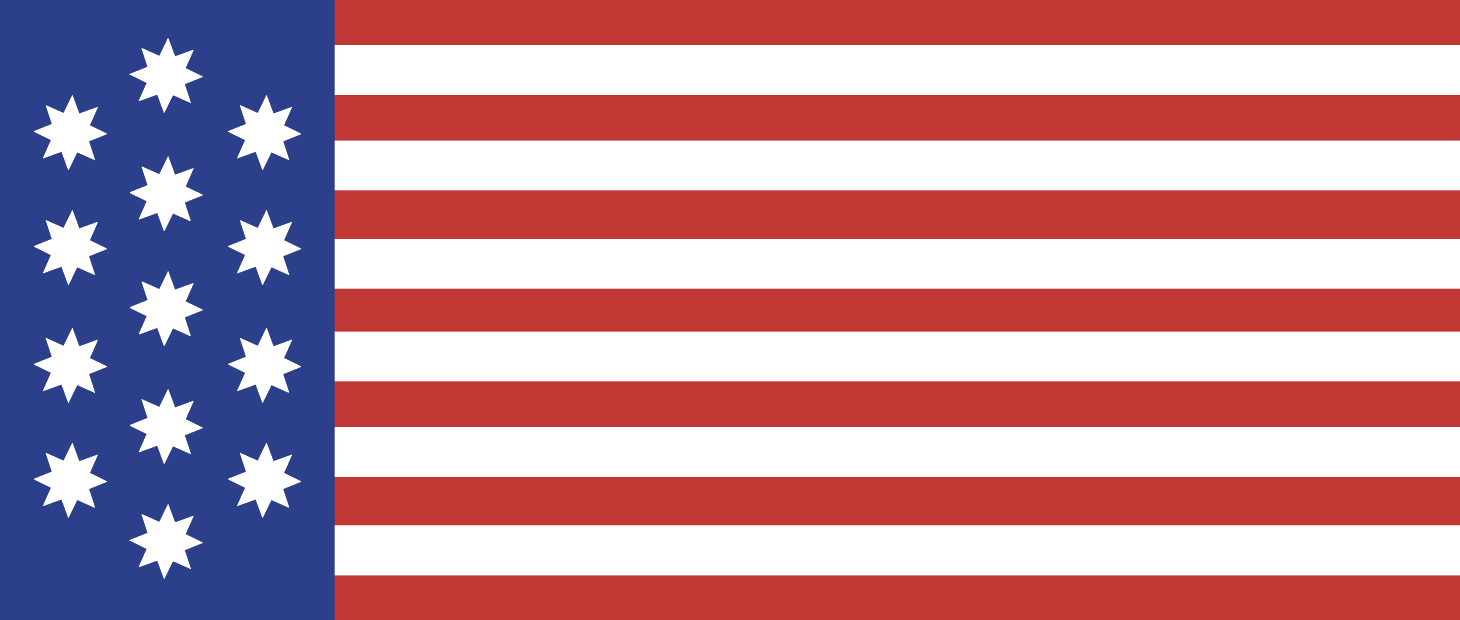
On December 23, 1783, George Washington, victorious military leader, resigned his military commission at the Maryland State House and retired to private life.
John Shaw was employed to ready the Maryland State House for this momentous event. He was a local inventor, assessor, undertaker, state armorer, merchant, City Councilman, and apparently, flagmaker. He created two large American flags, one to fly from the State House and one for the Governor’s Mansion.
What appears to be a Shaw Flag appears above the State House in Charles Milbourne’s 1794 watercolor “Image of Church Circle, 1794, Annapolis, MD”. Details of the flag are difficult to make out in the painting, but the star field seems to extend the entire height of the flag. A replica of this flag now hangs in the Maryland State House. Annapolis served as the first peacetime national capital and was where the Treaty of Paris was ratified, ending the American Revolution.
29. Fort Harmar Flag
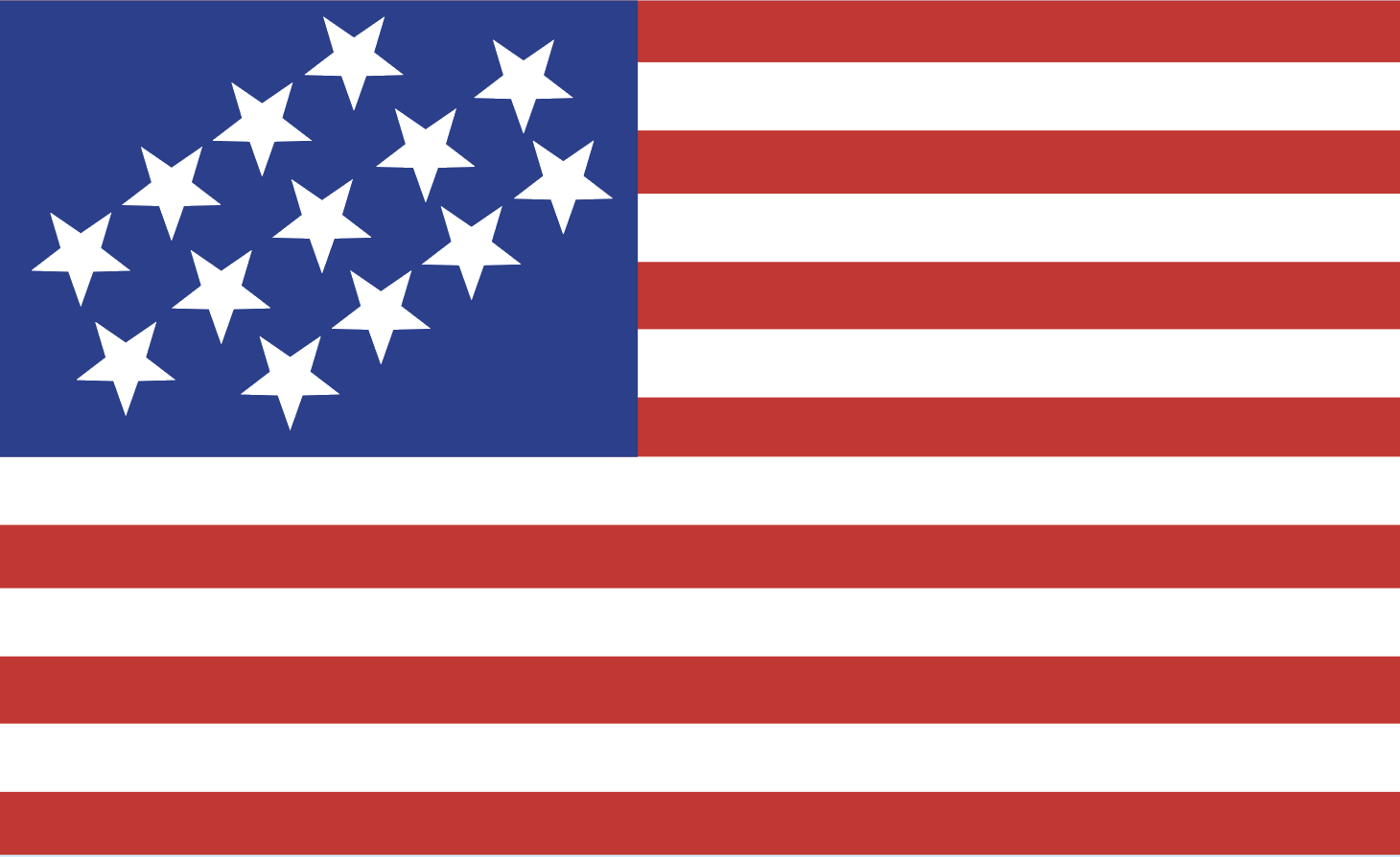
In 1784, Congress ordered Fort Harmar to be built at the junction of the Ohio and Muskingum Rivers, near present day Marietta, Ohio. Colonel Josiah Harmar was dispatched to the fort, which was meant to protect Native American land from pioneer settlers. Rather than discouraging these squatters, however, pioneers believed Harmar’s troops would protect them from Native American attacks and so the fort actually increased illegal settlement.
During construction, its said that a crude drawing of this flag was made on one of the walls, probably by workmen. Its of interest because the 5-pointed stars, placed in a 4-5-4 pattern, were placed at a unique 45-degree angle.
30. Nathan Beman Flag
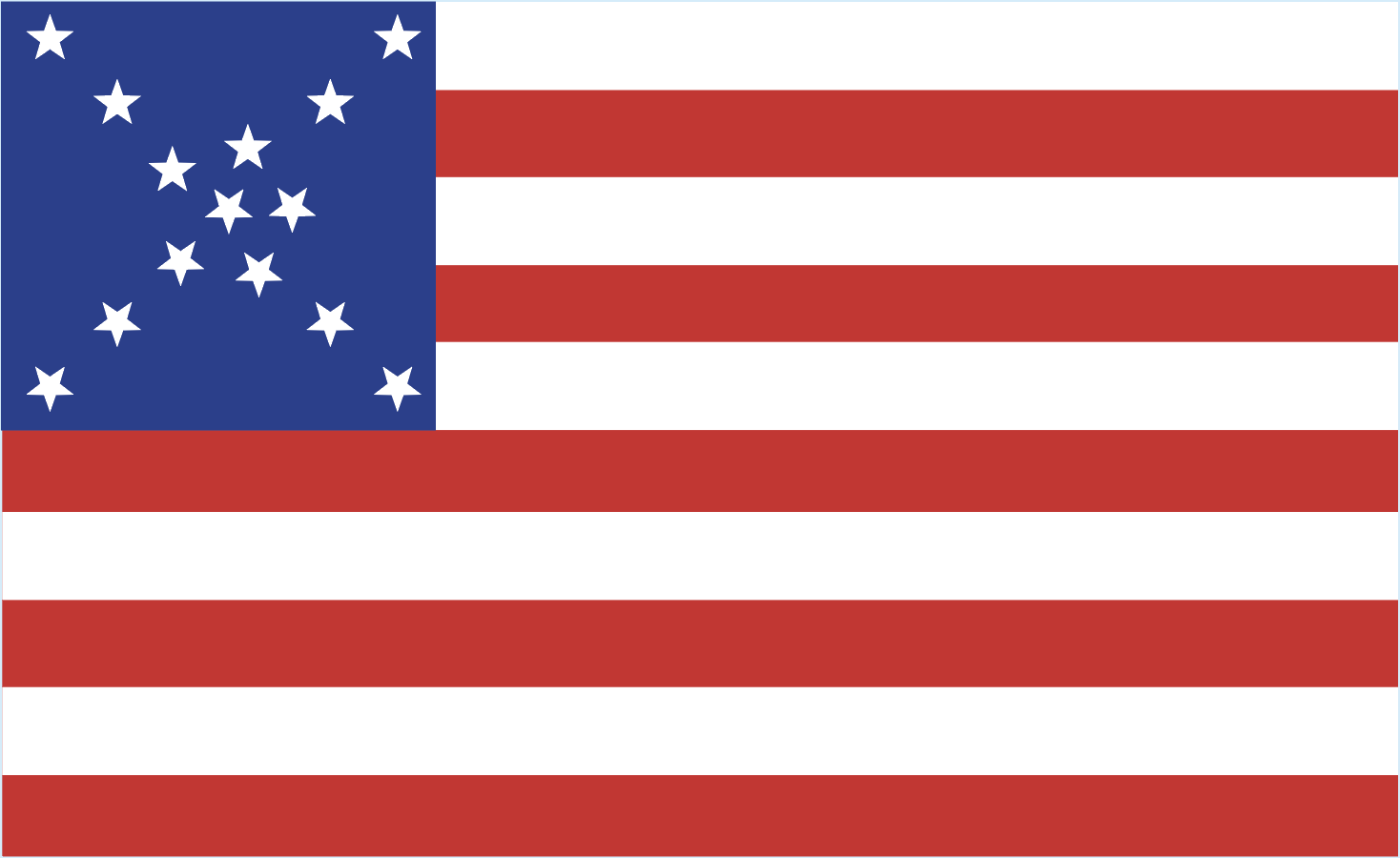
After Vermont was admitted as the 14th state in 1791, this 14-star flag was created. This flag is rare not only because its one of only three flags known to have 14 stars, but also because it only has 10 stripes.
It was created as a gift to Nathan Beman, received by him sometime between 1795 and 1815. Beman had been a guide for the Green Mountain Boys during the surprise attack on Fort Ticonderoga in 1775. That early morning attack was led by Ethan Allen and Benedict Arnold and captured crucial artillery that was later used to liberate Boston. It marked the first offensive victory of the Revolutionary War.
31. Star Spangled Banner
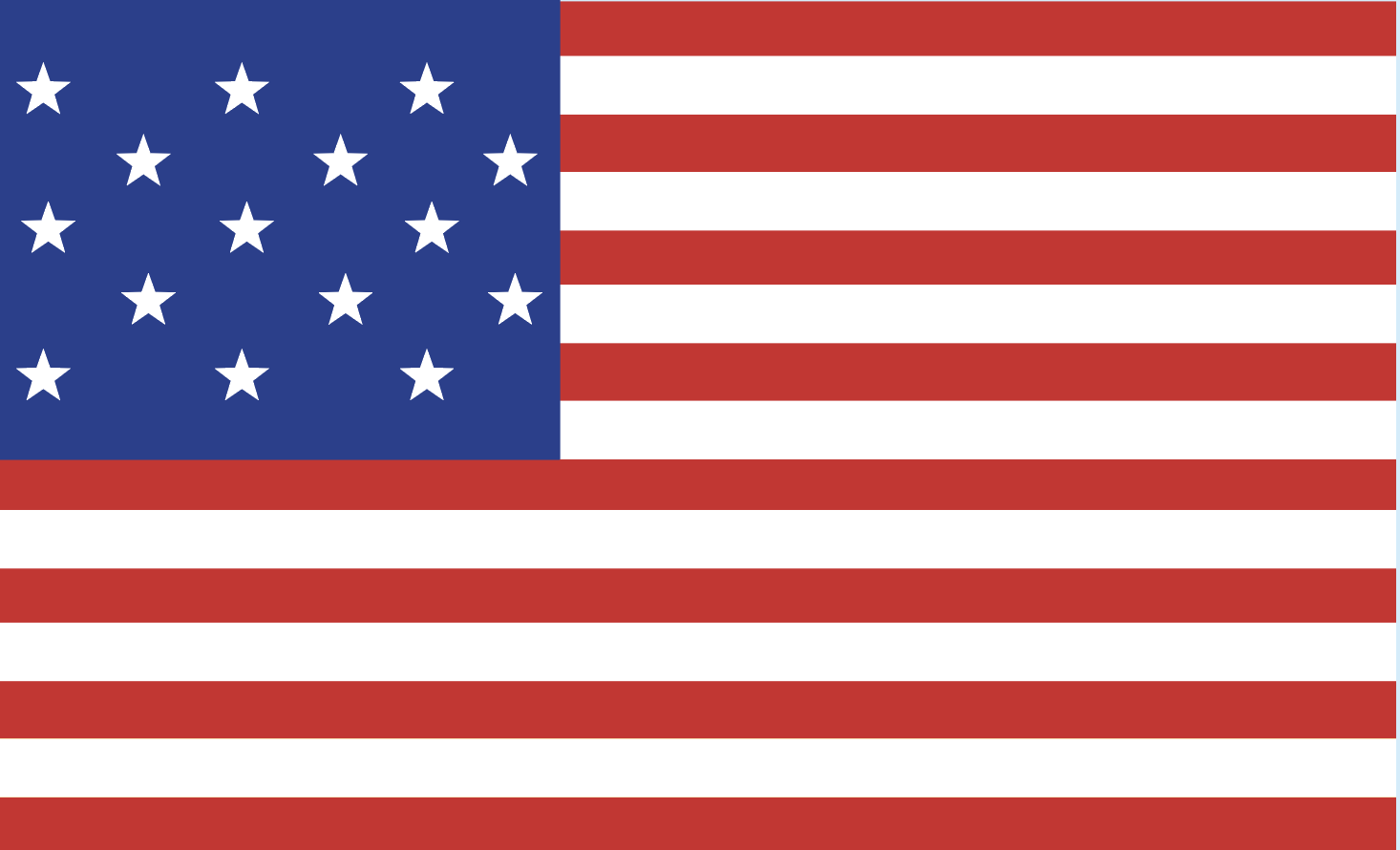
This flag, with 15 stars and 15 stripes (made after Vermont and Kentucky become states) became the official American flag on May 1, 1795. This flag was used for the next 23 years, and is the only official American flag to have more than 13 stripes.
War broke out soon after its design, in 1812, and was again against the British. On their way to Baltimore, the British burned the capitol building in Washington D.C. and took a local doctor hostage. Under a flag of truce, Francis Scott Key negotiated the doctor’s release but was detained on a British ship.
The next morning, British warships unleashed a devastating 24-hour bombardment on Fort McHenry. Throughout the next night, Key could look through a porthole and see a small American flag in the red glow of the rockets. The next morning, he saw a huge American garrison flag waving over the fort. The British attempt at Baltimore had failed. The event inspired Key to write a poem which became the “Star Spangled Banner.” This large flag is on permanent display in the Smithsonian Institute.
32. Lewis and Clark Expedition / Indian Peace Flag
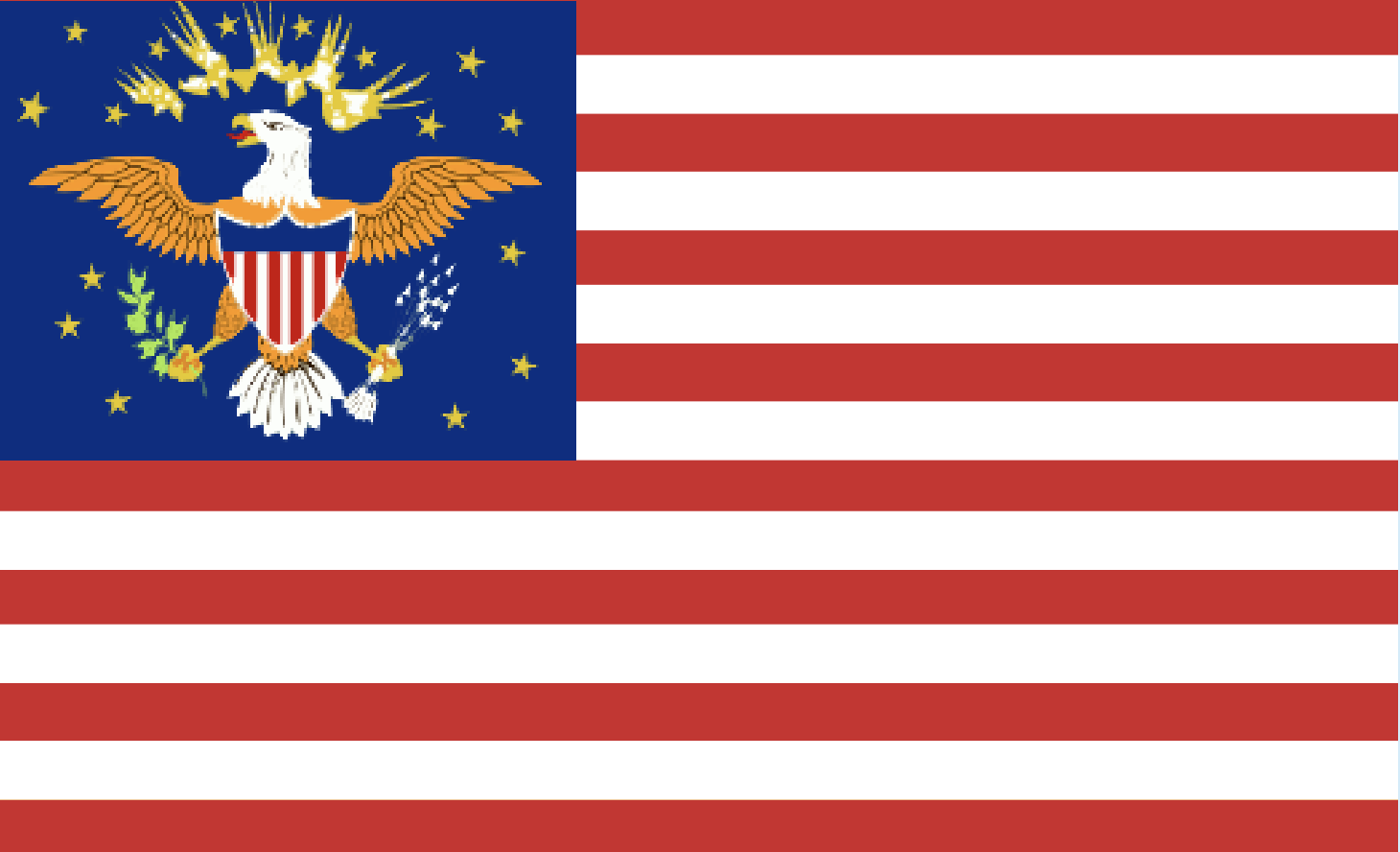
The Federal government gave flags like this to friendly Native American leaders throughout the 1800s. Since eagles were revered by both Americans and native tribes, incorporating them into the flag design was a good choice for this mission.
One task of the Lewis and Clark Expedition of 1804-1806 was to establish peace with the people living in the new Louisiana Purchase territory. Lewis and Clark carried several of these flags to give as tokens of peace. Native American leaders were encouraged to fly them as a symbol of loyalty to the United States. Only five Indian Peace Flags are still known to exist.
33. Colrain School House Flag
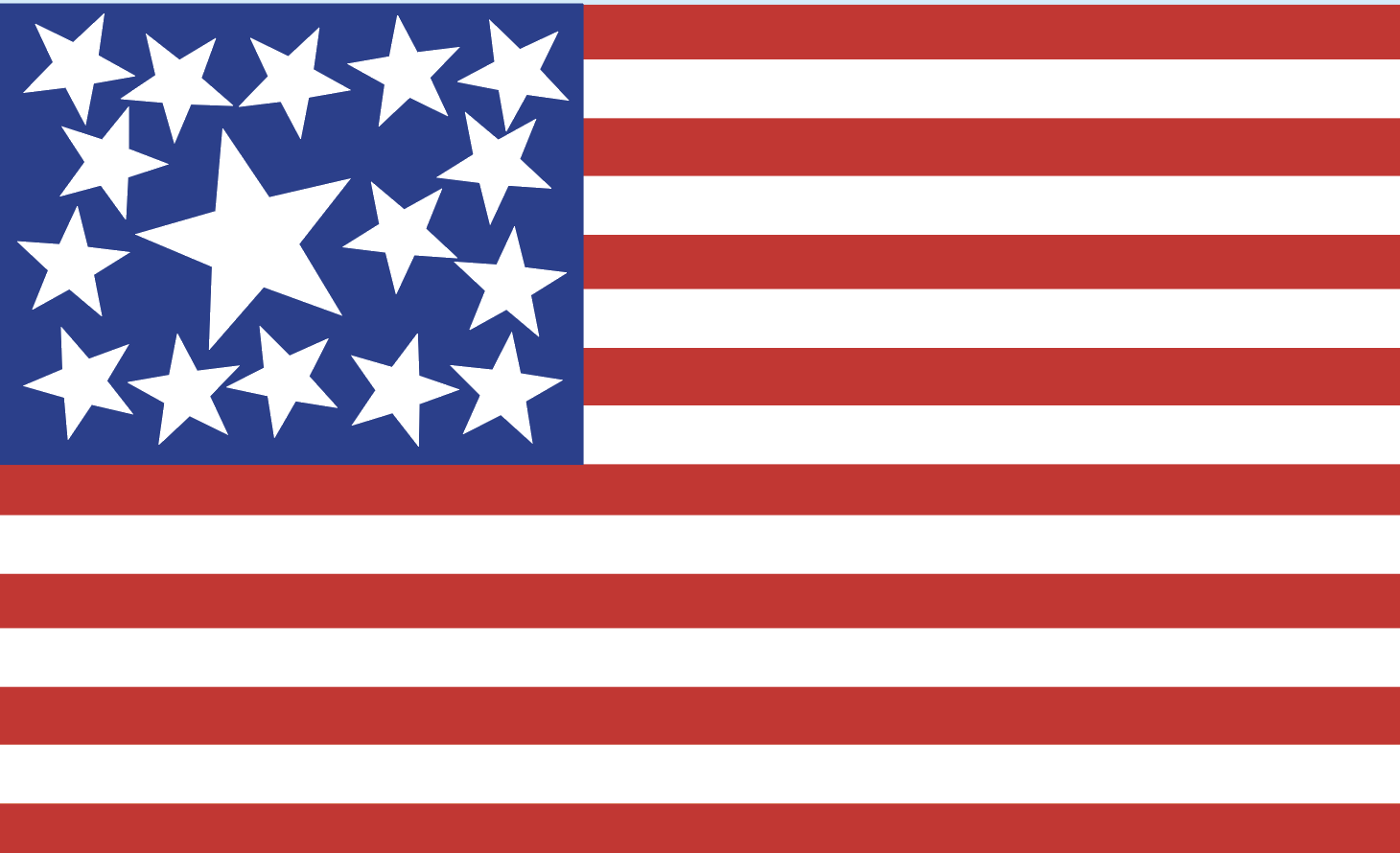
In 1812, this hand-sewn 16-star American flag was raised in Colrain, Massachusetts, and is believed to be the first instance of a flag being flown at a schoolhouse. It wasn’t until after the Civil War, more than 50 years later, that flying the flag at schools and other public buildings became a common practice.
34. Stonington Flag
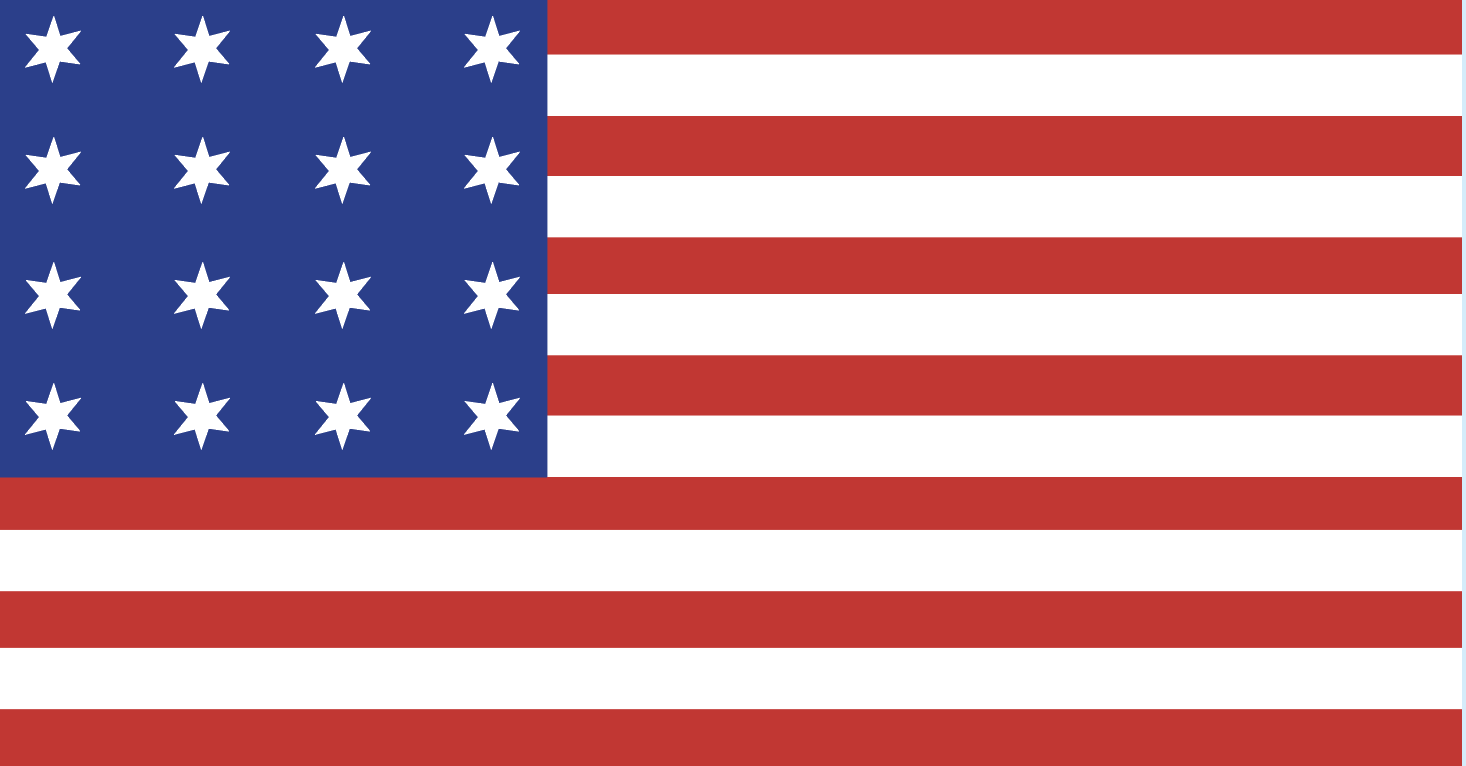
The War of 1812 lasted almost three years, with battles continuing until early 1815. This flag was flown over one such skirmish, at the Battle of Stonington. From August 9 to 13, 1814, this small Connecticut coastal town held strong against the British Royal Navy. Massively outnumbered 63-to-1, the local militia and residents were not deterred and used two 18-pound cannons against the British naval squadron of five ships and 160 cannons. The American resistance fighters caused significant British casualties, while suffering none themselves.
This unique 16-star, 16-stripe flag withstood the British bombardment, never once being lowered in spite of several direct hits.
35. 20-Star Flag
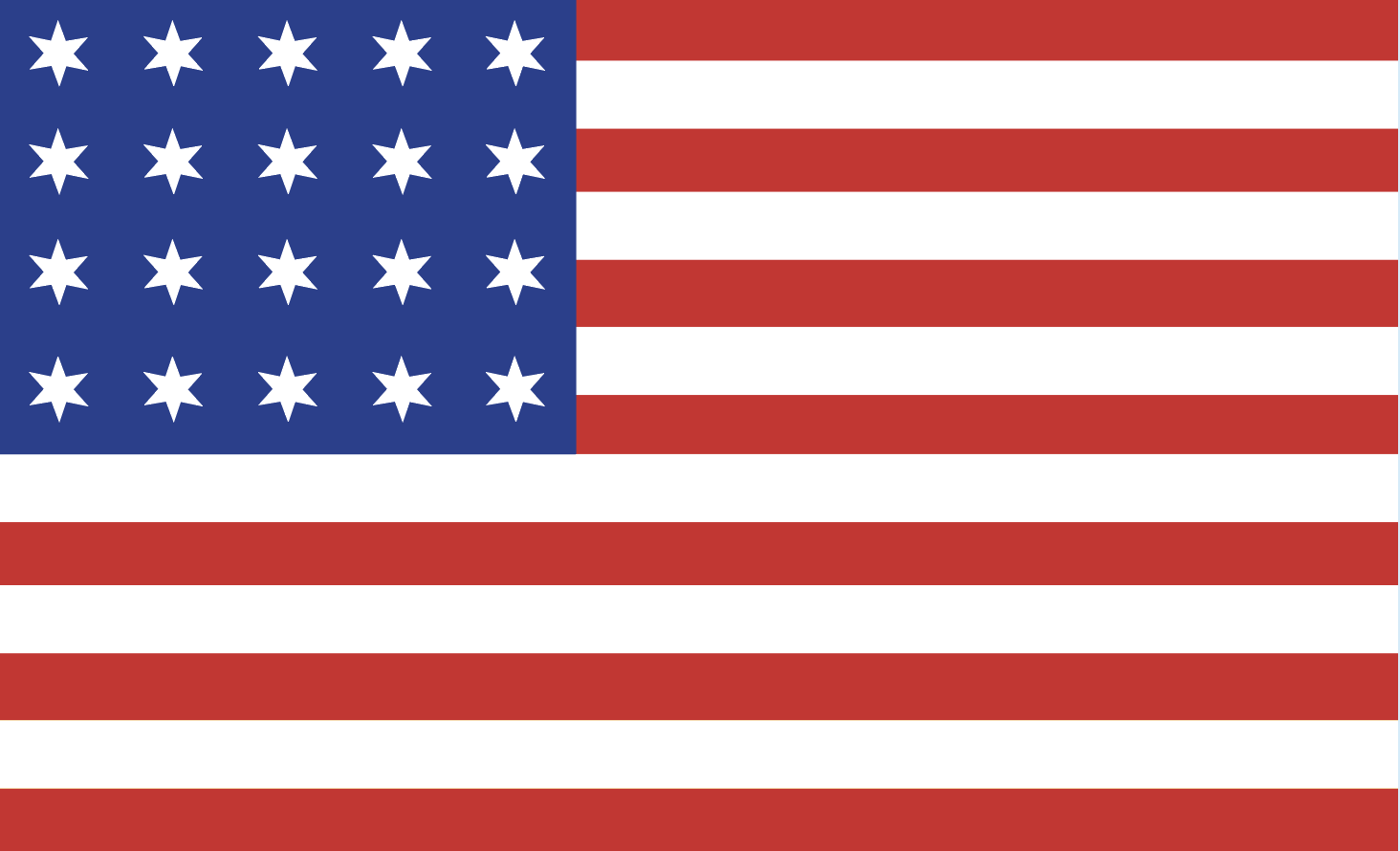
In 1818, five more stars were added to the flag, one for each of the new states of Indiana, Louisiana, Mississippi, Ohio, and Tennessee, bringing the total number of stars to 20. A Congressional committee was formed to determine how to adjust the flag in the future, with the addition of new states.
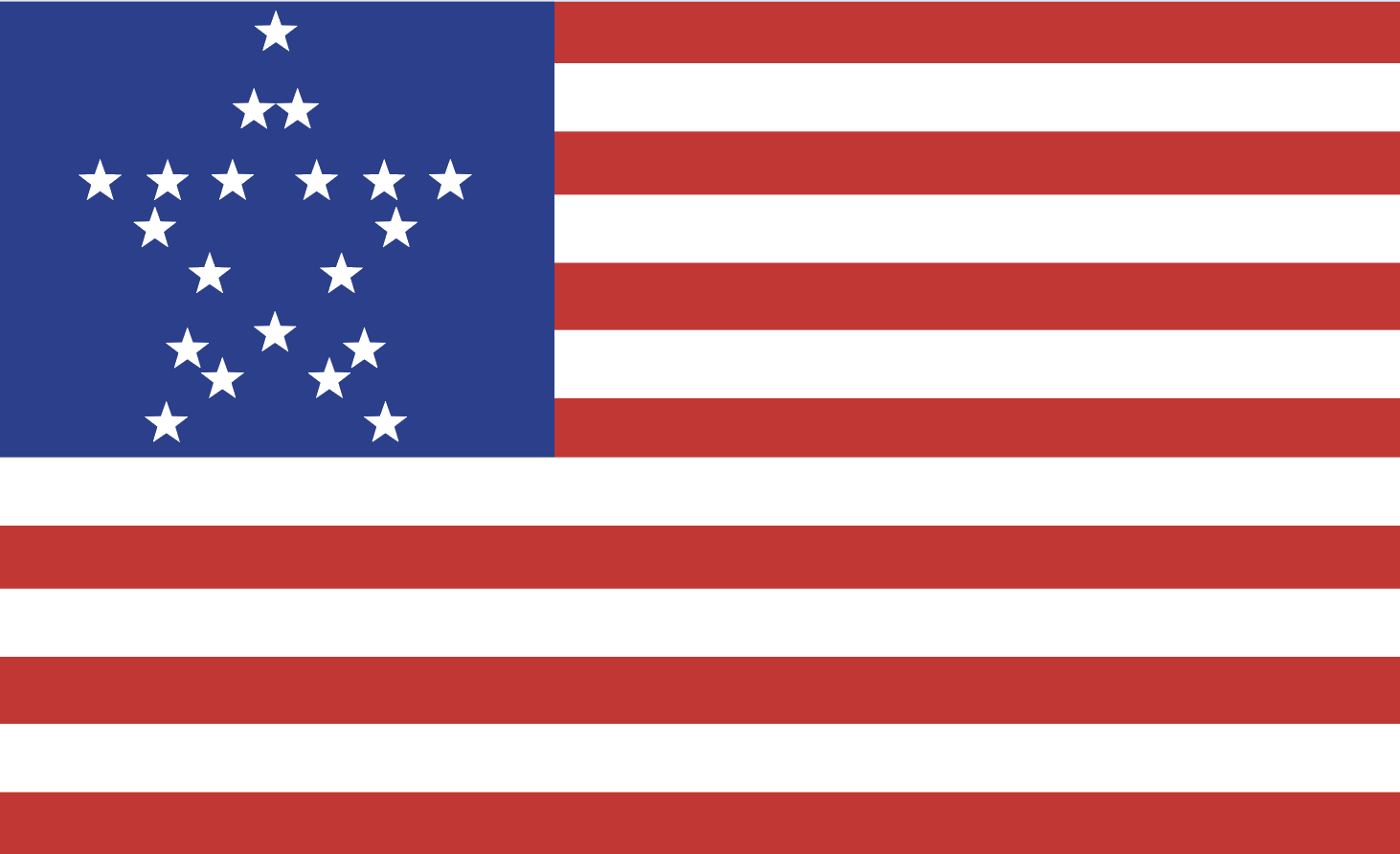
Three possible designs were discussed: a 13-stripe/20-star flag with the stars laid out in the shape of a great star; a 13-stripe flag with an eagle in the canton; and a flag divided into four sections featuring stars, stripes, an eagle, and the goddess of Liberty.
The Flag Act of 1818 was passed by Congress and stipulated that a new star would be added to the flag as new states joined the United States, but the number of stripes would always remain at thirteen to honor the original colonies. The stripes honor our history while the stars show our present. This Act also specified that new flag designs would become official on the first 4th of July following the admission of any new state. No provisions were made for how the stars would be arranged, thereby creating many variations in the years to come. Military flags, however, always featured an orderly square of stars, such as what is shown to the left.
36. Great Star Flag
In 1803, Thomas Jefferson bought the Louisiana Territory from France, 828,000 square miles of land west of the Mississippi River, effectively doubling the size of the new nation. Settlers moved west for various reasons; economic opportunity especially with cheap land through the Homestead Act, to find gold or religious freedom, for jobs in industries like cattle and logging, and the promise of adventure. Settling this new territory was made even easier with the development of the railroad.
Manifest Destiny was the rallying cry for the pioneers. This was the belief that Americans were divinely ordained to expand across North America, from the Atlantic to the Pacific, to spread democracy and capitalism.
This 20-star flag flew over the Capitol dome in Washington D.C. in 1818. Great Star patterns on national flags soon became a favorite of American flag makers, with their popularity lasting throughout the 1800s. Flags whose stars form a larger star are called either Great Star Flags or Grand Luminary Flags, the terms are interchangeable.
37. Old Glory / 24-Star Flag
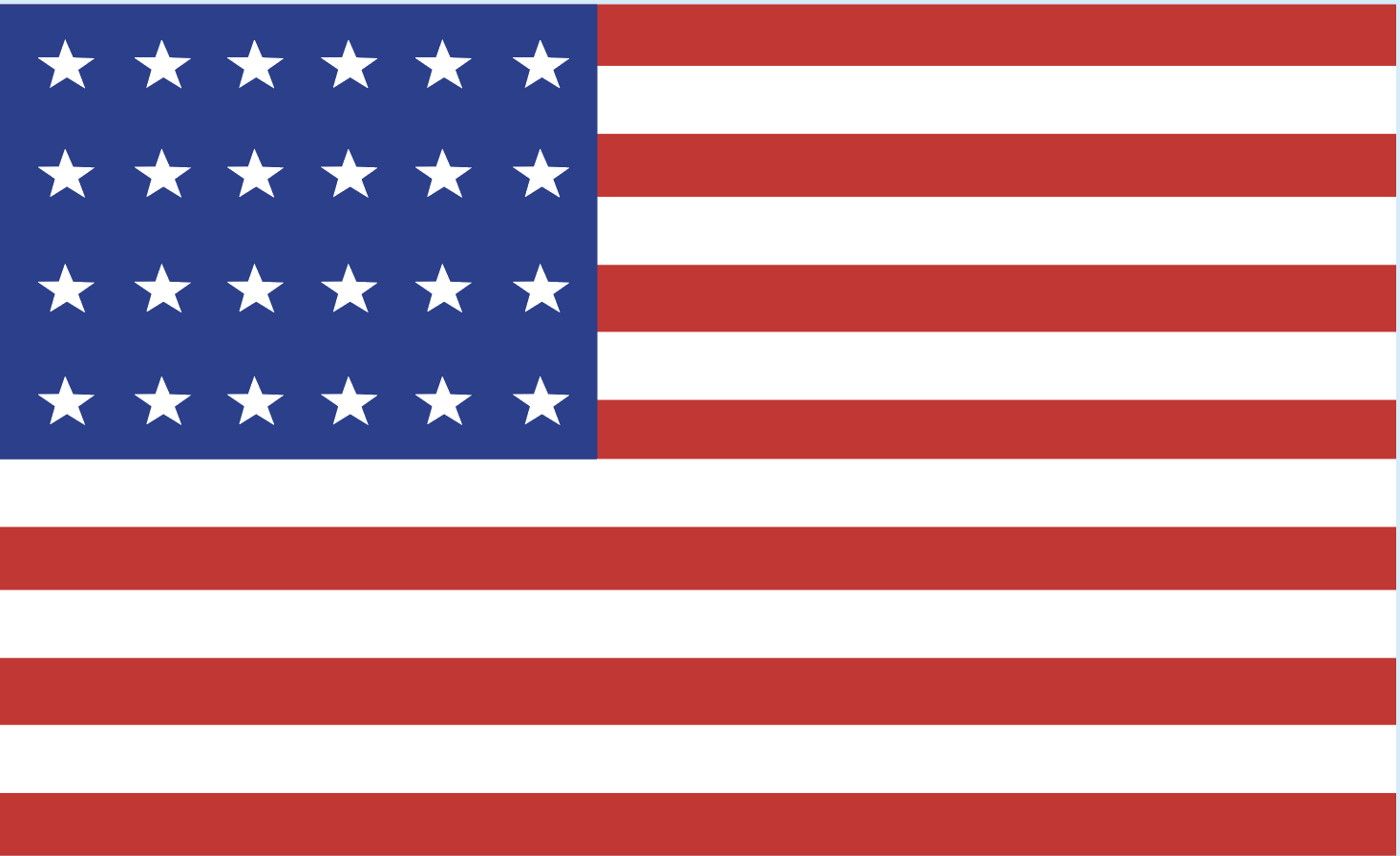
Although the nickname Old Glory is now used for all American flags, at first it referred specifically to a flag owned by a Salem, Massachusetts sea captain named William Driver. His mother and a few female admirers handmade this flag for him in 1823 for this birthday. As it unfurled on the mast of his whaling vessel, the Charles Doggett, the Captain was heard to exclaim “Old Glory!” He also referred to it by that name in his journals. Driver took the flag on two trips around the world, and then he retired to Nashville, Tennessee in 1837.
Old Glory became a well-known sight in the city. Driver proudly displayed it in town for all patriotic holidays. By the start of the Civil War in 1861, he had modified it to show 34 stars and added an anchor in the corner to indicate his sea service. He hid the flag between two quilts when Tennessee joined the Confederacy. When Union forces retook Nashville, Driver once again hung his flag in the city, this time from the dome of the capitol building! This flag was donated to the Smithsonian Institute in 1922.
38. Grand Luminary Flag
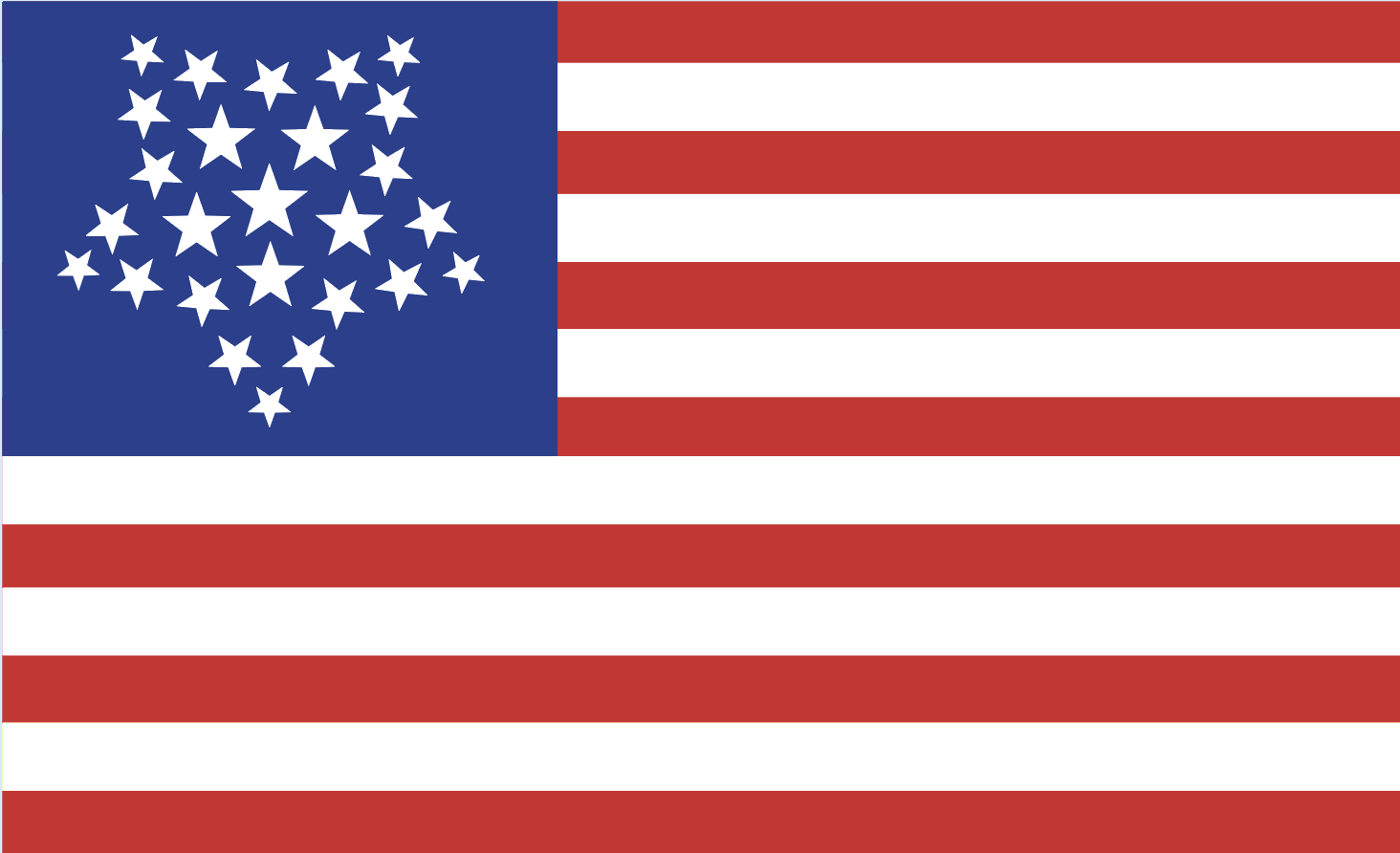
The 1837 Grand Luminary flag is a 26-star U.S. flag adopted on July 4, 1837, following Michigan’s admission to the Union. It features a distinctive pattern where smaller stars are arranged to form one large star, symbolizing America’s motto E Pluribus Unum, which translates to “Out of many, one.”
There were several different flags with star designs used between 1837 and 1845. This flag has a large star in the center, with five stars forming a star pattern around that, and the remaining 20 stars forming a larger star around them.
39. Double Wreath Design
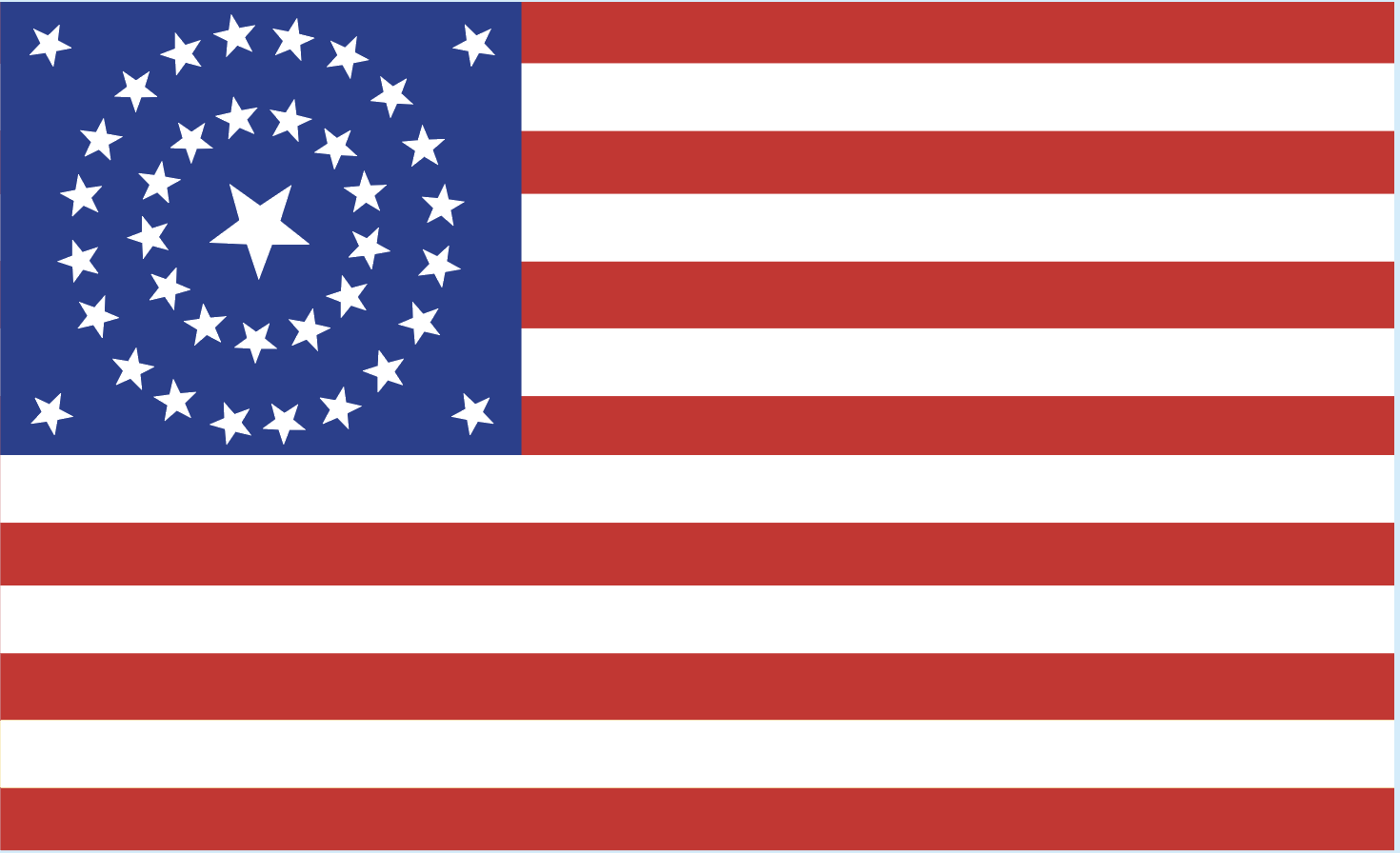
This flag uses a popular 1840s star pattern called a Double Wreath. At that time, new techniques to print on silk and cotton had been discovered that allowed small flags to be produced more economically and sold at low prices. This advancement made them a natural addition to political rallies and flag-waving campaigns.
The pictured flag probably dates from the 1848 presidential election. The Double Wreath design was also used on various national flags of mourning from 1840 to 1860, with black bunting added to the outside edges.
40. Fort Sumter Diamond Flag
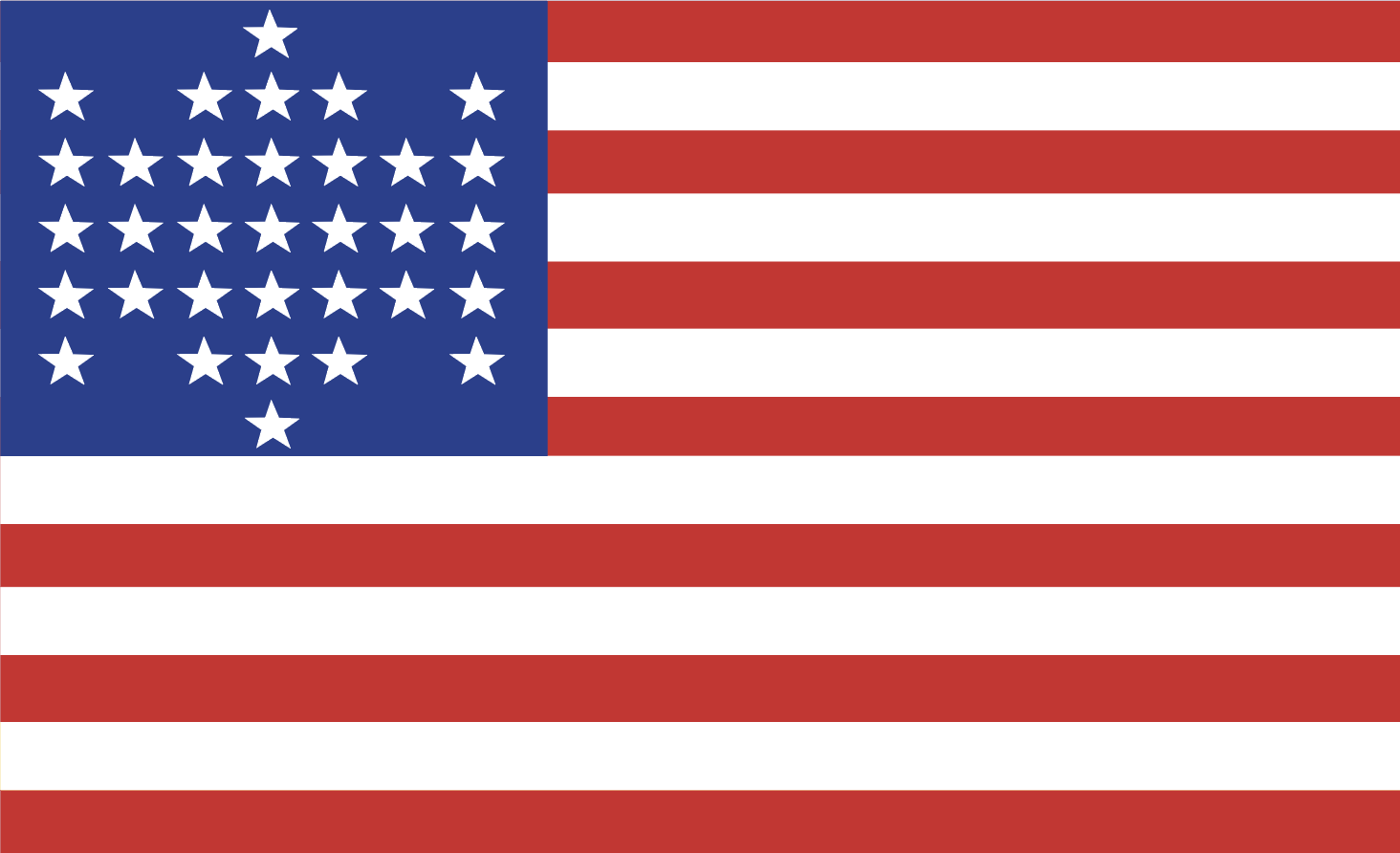
This flag is sometimes called “the flag that started a war.” After Abraham Lincoln was elected president in November 1860, dissent bloomed among American states and before his inauguration in January 1861, seven states seceded from the Union.
In December 1860, South Carolina seceded and wanted control of Fort Sumter, in its Charleston Harbor. In mid-April 1861, after a bombardment that lasted 34-hours, Union Major Robert Anderson lowered the flag and surrendered the fort.
That Fort Sumter flag went on tour across the north, raising funds for the war effort. The invention of the sewing machine made flags affordable for average Americans, and soon flags were flying from every church steeple and government building.
As General Sherman advanced through South Carolina in 1865, Fort Sumter was again under siege, this time by the Union. The siege lasted 545 days, from 1863 to 1865, before Confederate forces abandoned the heavily bombarded, ruined fort. Four years later but on the same exact day, Robert Anderson (now a General) raised that same flag over the fort. A few hours later, in a theater 500 miles to the north, an assassin shot President Lincoln, thereby closing this chapter of American history.
Between 1845 and 1867, many forts used garrison flags with a diamond pattern for their stars. This pattern was visually striking and easily allowed for additional stars.
41. Great Cross Flag
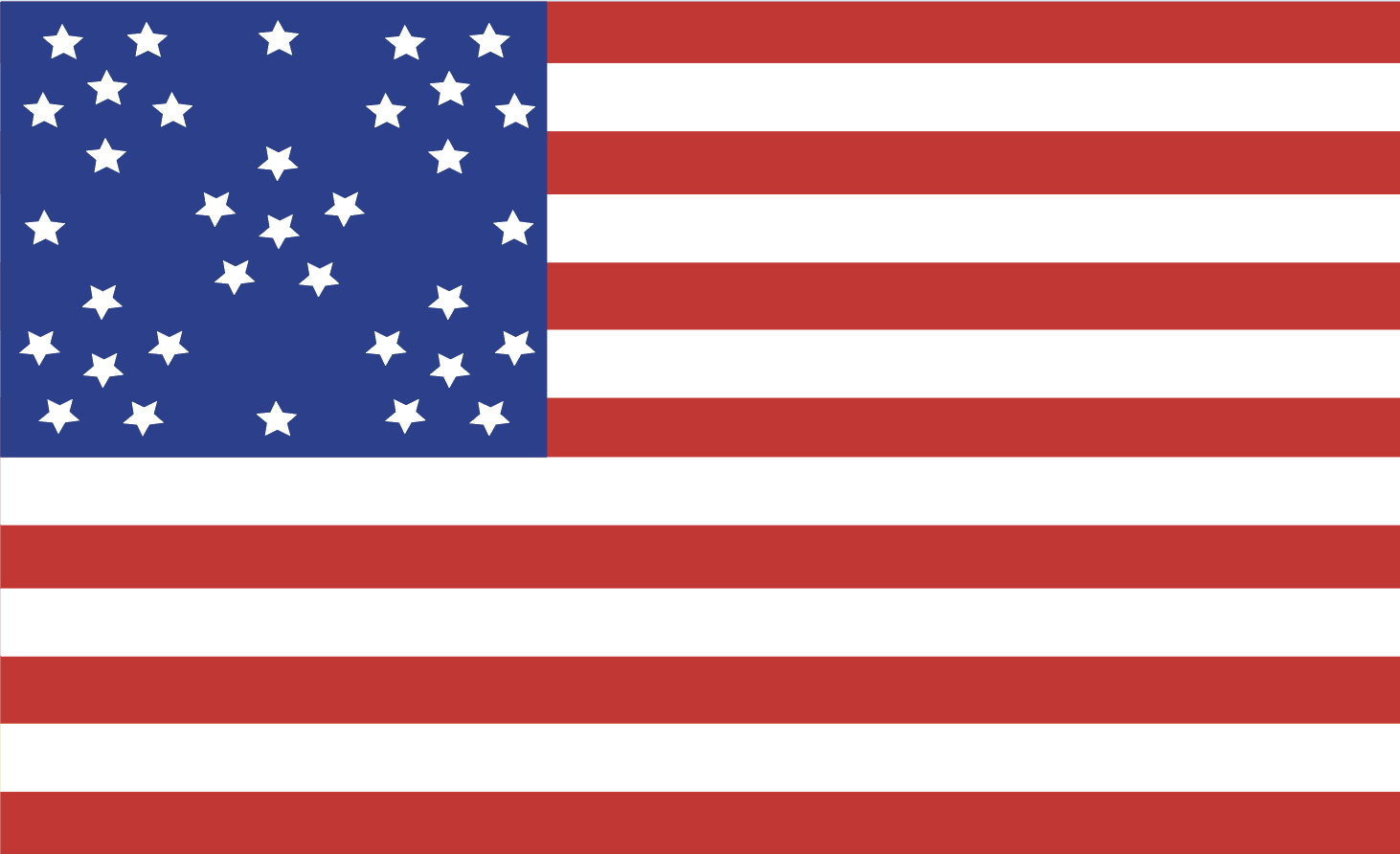
This clever variant has five clusters of 6-stars each, forming a Saint Andrew’s Cross. The four remaining stars, needed to create this 34-star design, are centered on the top, sides, and bottom, forming a Saint George’s Cross. Because these two crosses exist within this design, its called the Great Cross Flag.
42. Great Flower Flag
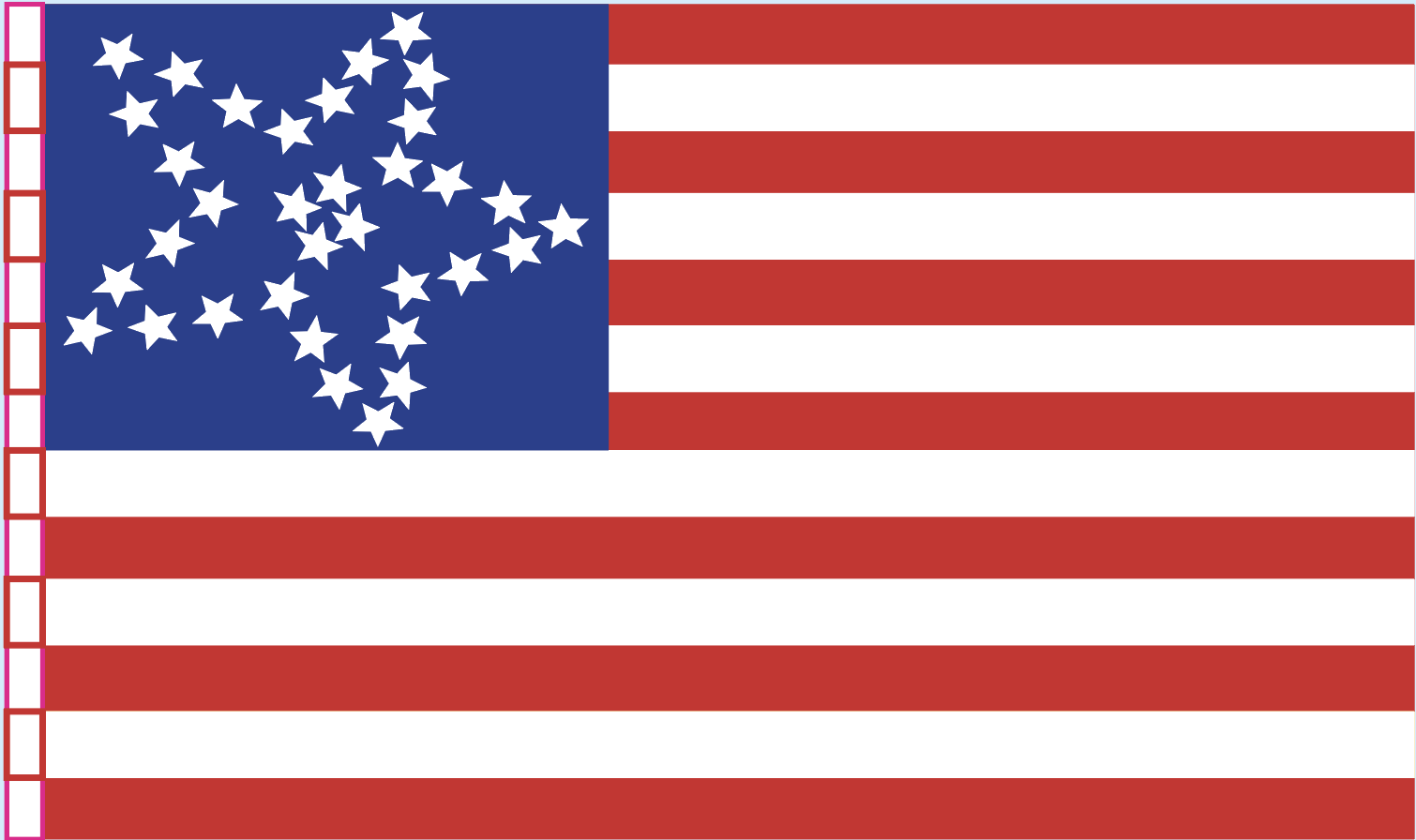
The Great Flower Flag has five asymmetric petal shapes that loop out from a group of off-center stars, creating a graceful flower pattern of 34 stars. This flag is also sometimes called the Candy Stripe Flag because of the red and white “candy stripe” running down the left side.
43. 48-Star Flag
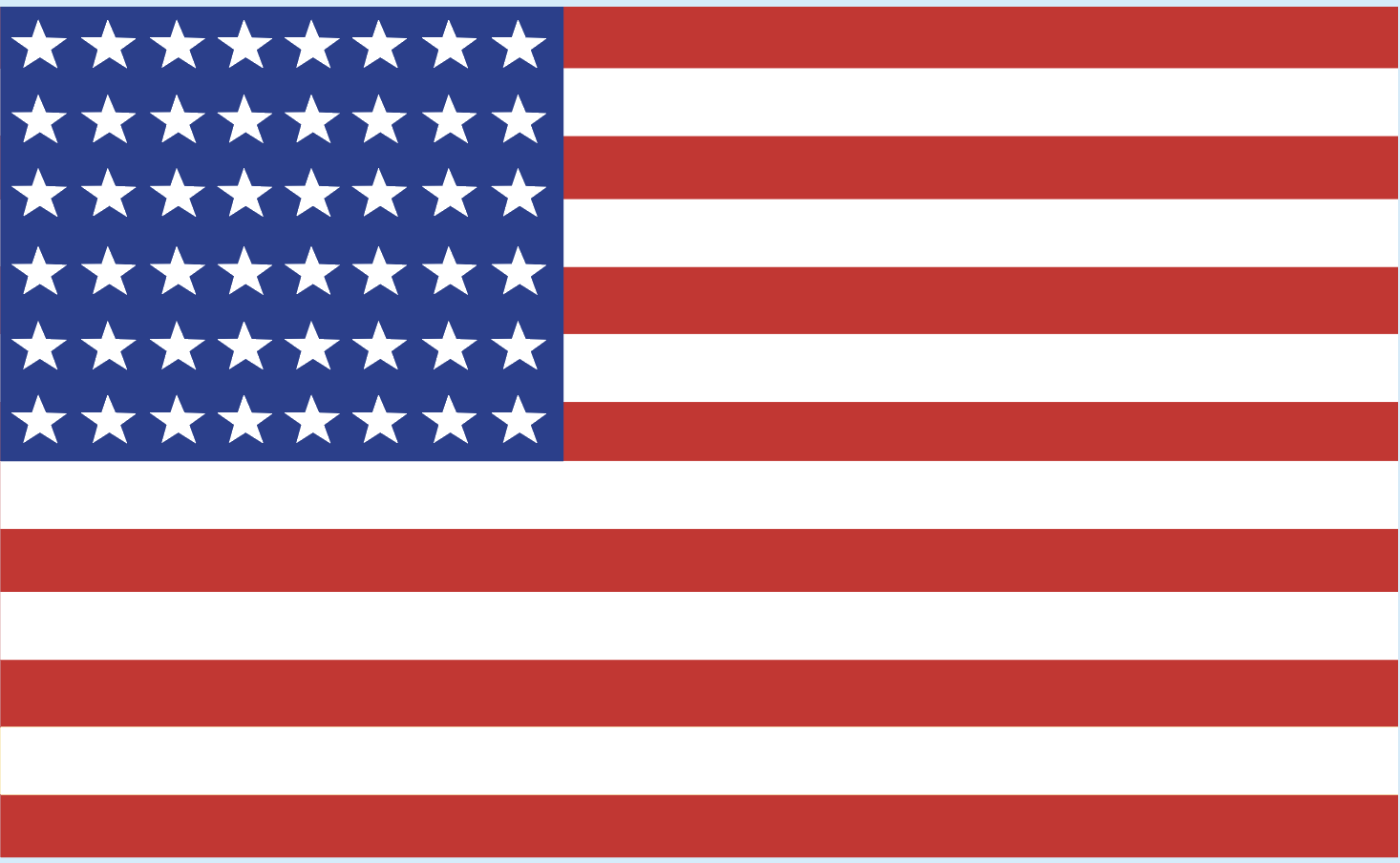
On July 4th, 1912, President Taft declared this 48-Star Flag the official U.S. flag and also, for the first time, specified a specific layout for the stars. In the next 47 years, eight presidents served under this flag: Taft, Wilson, Harding, Coolidge, Hoover, Roosevelt, Truman, and Eisenhower. This flag is still valid today.
In 1916, President Woodrow Wilson made a Flag Day proclamation, which set aside June 14 every year to honor the American ensign and its place in our national story. However, it wasn’t an official nationwide observance until 1949, with a proclamation made by President Truman.
This flag flew during many important events in the nation’s history, including the Great Depression, two world wars, and the Korean War.
During WWII, a platoon of Marines climbed to the top of Mount Suribachi on the island of Iwo Jima on the morning of February 23, 1945, after five days of intense combat. There, they planted a small flag. After seeing it, the commanders on the beach below ordered a larger flag to be raised, one that could be seen far and wide. Another platoon of Marines was tasked with raising the larger flag, and that moment was captured by photographer Joe Rosenthal. It soon became one of the most iconic photos in American history, winning a Pulitzer prize.
44. 50-Star Flag *This flag is not found on a street banner, instead find it flying in front of City Hall.
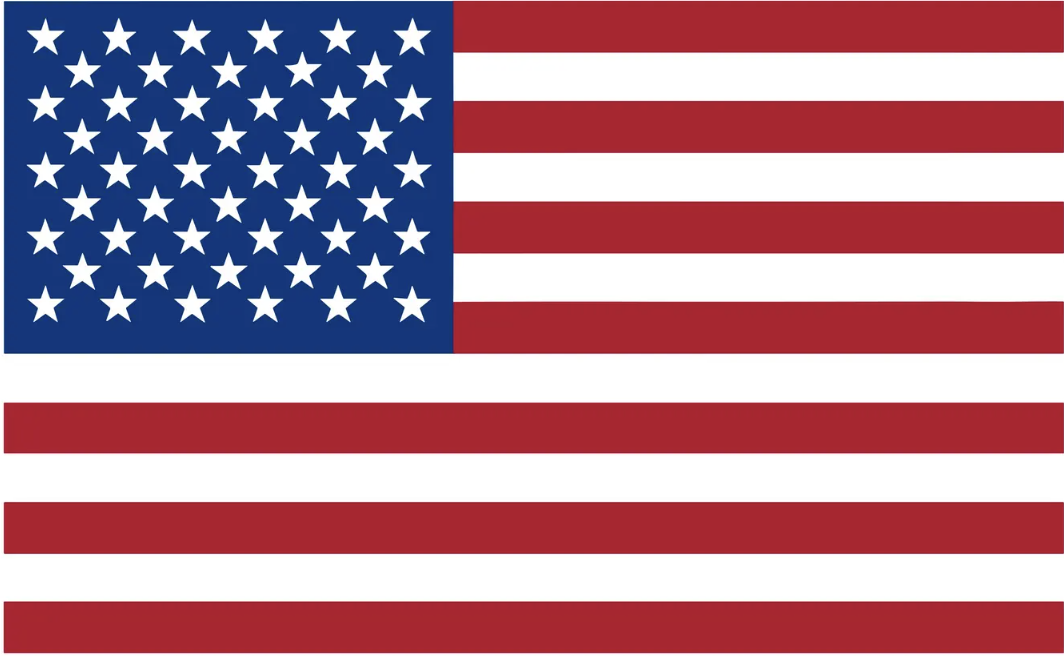
You may want to take a moment and recite the Pledge of Allegience to it.The admission of Alaska and Hawaii in 1959 brought the number of stars on the flag to 50. The Eisenhower Administration asked schools to send suggestions for a new flag design and they received thousands of responses. This was the winnig design. This flag became the official flag of the United States on July 4th, 1960 and has flown over America longer than any other flag.On July 20, 1969, Buzz Aldrin and Neil Armstrong, planted this flag on the moon, making it the first flag planted on the moon and in space. Since then, six more flags have been planted on the moon during Apollo missions.
Pledge of Allegiance
I pledge allegiance to the flag of the United States of America, and to the republic for which it stands, one nation, under God, indivisible, with liberty and justice for all.
In 1892, when the country was honoring the 400th anniversary of the discovery of America by Christopher Columbus, the magazine Francis Bellamy wrote for created a campaign to encourage patriotism among American children. President Harrison made a proclamation that all schools should fly the American flag, and Bellamy wrote the Pledge of Allegience and published it in his magazine.
In 1923, the Daughters of the American Revolution and the American Legion held a National Flag Conference. As a result, the words, “of America” were added to the pledge. This change was to prevent immigrants from pledging allegience to their native country while reciting the American pledge.
During the Cold War in 1954, President Eisenhower added the words “under God” to distinguish American ideology from the “godless” Communism of the Soviet Union.
QUICK FLAG CODES
• The union should always be at the top left when displayed.
• The flag should be illuminated at night.
• The flag is flown at half-staff during times of national mourning.
• American flags should never touch the ground.
• Worn-out flags should be disposed of properly. In Marshall, take worn-out flags to the Veterans Office in the Calhoun County Building on Green Street where you can also pick up a new flag!
For more flag codes, please refer to the US Flag Code on the House website: uscode.house.gov/view.xhtml?path=/prelim@title4/chapter1&edition=prelim
SOURCES
www.ushistory.org
www.gettysburgflag.com
www.mariettasar.com
www.americanflags.com
www.wikipedia.org
www.americanflagstories.net
www.revolutionarywar.us/flags/
www.loeser.us/flags/us_flags.html
www.battlefields.org (numerous pages/articles)
www.nationalflagfoundation.org/flag-history-evolution/
www.battlefields.org/learn/articles/short-history-united-states-flag
Smithsonian’s Natural Museum of American History, www.americanhistory.si.edu/collections/object/nmah_463145
“The History of the National Flag of the United States of America” by Schyler Hamilton; Lippocott, Grambo & Co 1853
“The Origin of the American Flag” by Teifair Marriott Minton, Journal of the Society for Army Historical Research, April 1929, pp. 114-120
“Flags Important in American History” by Daniel W. Hoff, The Journal of Education, May 1929, pp. 559-563
“The Naval Flag of the American Revolution” by Hugh F. Rankin, The William and Mary Quarterly, July 1954, pp. 339-353
While every effort has been made to ensure accuracy, if you find any errors please let us know by calling the Marshall Welcome Center at 269-781-5163 and asking for Kimber, or CLICK TO EMAIL.
Step back in time as you explore Marshall’s beautiful historic homes, each with unique architecture and stories to tell.

Every step reveals a story from the past, making this walk a must for history lovers and curious explorers alike.

Experience the heart of Marshall on this walk through downtown, where charming shops, local eateries, and historic buildings line the streets.