

History of Marshall Manufacturing
Around 1900, with access to roads, railway and rivers, Marshall exploded as a major manufacturing hub.
Over the years a number of different types of manufacturers have made Marshall their home. Shown here are several types of products that were made in Marshall. For a company to succeed, it needed three things: products people believed in, a strong transportation network, and a reliable postal system to ship orders across the country. Marshall had all three.
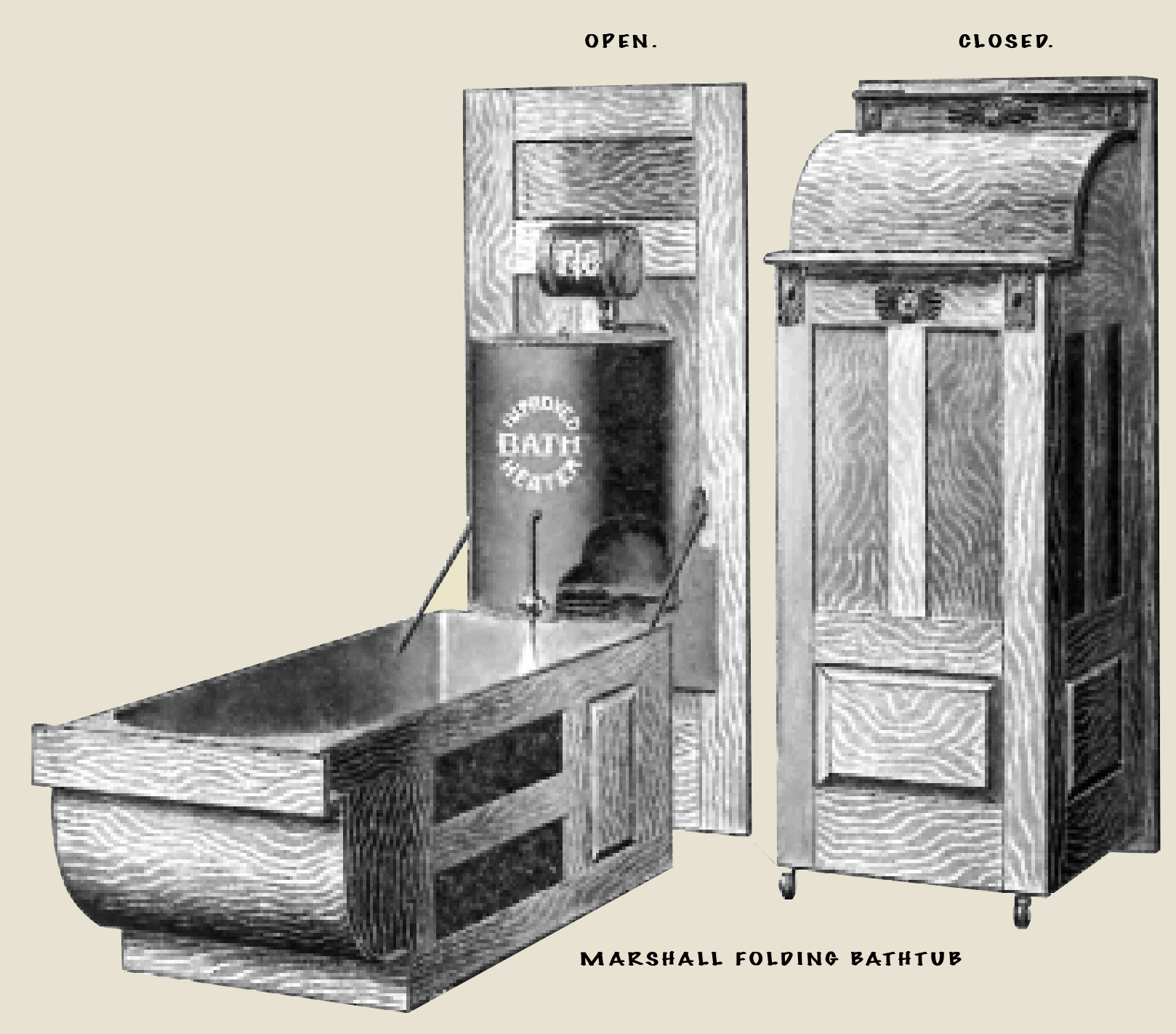
FOLDING BATHTUB
Founded in 1892, the Marshall Folding Bath Tub Company emerged at a time when American homes. and expectations for comfort and hygiene, were rapidly changing. As indoor plumbing spread unevenly, the company’s patented “cabinet bath” offered a clever solution: a full‑sized wooden tub with a bult-in water heater, lined with zinc or copper, that folded into an attractive piece of furniture after each use.
Sold through national catalogs and shipped across the country, these tubs reflected the rise of mass‑market retail and the growing belief that modern living could be brought into any home. Boarding houses, rural families, and city renters used them to add privacy and convenience to older spaces. Though the company lasted only a few decades, its products capture a pivotal moment in American consumer culture and stand as a testament to Marshall’s inventive spirit.
PATENT MEDICINE TOWN
Marshall became an unexpected but ideal center for the patent medicine industry, a booming trade in the late 19th and early 20th centuries. Patent medicines (often over‑the‑counter tonics, liniments, and “cure‑alls” sold under brand names) relied less on proven medical value and more on public trust, bold advertising, and national distribution. Because almost all patent medicines contained cocaine or strong whiskey, the Pure Food and Drug Act of 1906 put an end to almost all patent medicine businesses.
Comstock
Dr. O.C. Comstock Jr. was the first person in Marshall to manufacture patent medicines. The source of his wealth was “Comstock’s Ague Pills” used to fight Ague, a type of malaria caused by mosquito bites, of which Marshall had more than its share. Soon Comstock was joined by over 50 others, manufacturing cures for all types of ailments, not all of them safe or effective.
F.A. Stuart
Marshall had two medicine success stories, Brooks Rupture Appliance Company (and the F.A. Stuart Company, both of which were in business for decades. Stuart's most famous compound was Stuart’s Dyspepsia Tablets which promised to ease indigestion. If he would have added fizz, like his competitor Alka-Seltzer did, we might still be using his product. BTW, the fizz adds nothing to the medicine, its simply an advertising gimmick.
Brooks Appliance
Charles E. Brooks became disabled in 1880 with an abdominal rupture (hernia) while moving mill stones at work. While convalescing at home, he and his wife Ellen designed a new style of truss that gave him great relief. Ellen made the truss on her home sewing machine.
He went back to work at the mill, but word spread of this new design and soon they started a home business, selling their innovative trusses in Marshall and Battle Creek. They did so well that Charles left his mill job in 1897 and opened a store in downtown Marshall. The business took off.
The Brooks company expanded rapidly, even internationally. After his father died in 1913, the business was run by Harold, his brother Louis, and their mother Ellen. Harold serving as president until his retirement in 1952 and invested much of his fortune back into his hometown. You can read more about Marshall's Preservation Movement HERE.