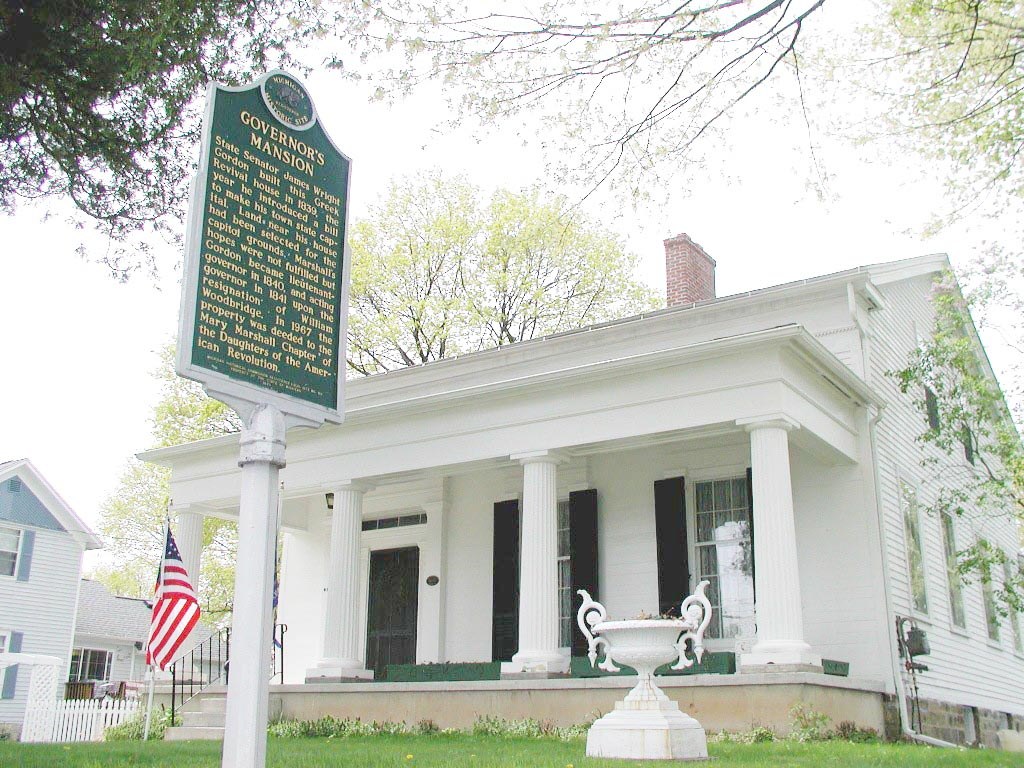
A Capital Idea
With its central location, Marshall anticipated becoming the capital of Michigan.
Marshall was established in 1830 and Michigan became a state in 1837. By the early 1840s, the new Michigan government had a plan: place the most important state destinations along Territorial Road, a route that linked Detroit to Chicago. The state university would be built in Ann Arbor, Jackson would get the state prison, and the state capital would be in Marshall. At that time, Marshall had a significant number of businessmen and politicians as citizens, so this plan made a lot of sense.
Marshall was so sure of winning the vote that a large area of land was set aside on the south side of town and named Capital Square. Lots in this section were sold at fantastic prices in anticipation of the decision.
The Michigan Constitution of 1835 stated that a permanent location for the capital needed to be found by 1847. Twelve towns submitted proposals that their towns be chosen: Ann Arbor, Albion, Battle Creek, Corunna, Byron, Detroit, Dexter, Eaton Rapids, Grand Blanc, Jackson, Lyons, and Marshall.
The House of Representatives took a first vote in which Lyons received 30 favorable votes and was declared the winner, Marshall was short by one, receiving only 29 favorable votes. However, at the next meeting the vote was reconsidered, and an unnamed tract of land in centrally located Ingham county was chosen by a vote of 35 to 27. Additional votes were taken but the lead only grew stronger.
Many names for the new capital were considered, including Washington, Cass, LaFayette, Tyler, and others but in the end, Lansing was chosen.
The name honors Lansing, New York, the hometown of many of its original settlers. That town was named after John Lansing, Jr., a prominent American Revolutionary War figure.
To learn more about this time in history, please visit the Governor's Mansion Museum at 107 S Marshall Avenue. CLICK HERE for museum details.